
 AR
AR
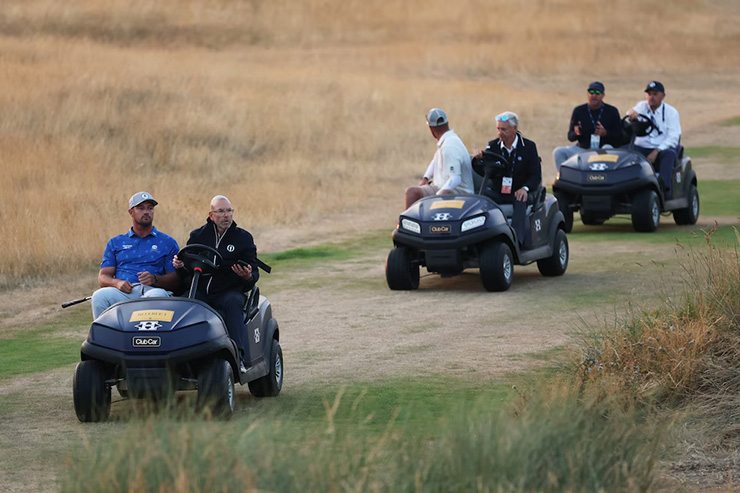
In the Rules of Golf, Rule 8.1 states that a player is prohibited from improving the “conditions affecting the stroke.” That includes the player’s lie, the area of his intended stance, the area of the player’s intended swing and the player’s line of play.
During the second round of the Open Championship on Friday, the R&A determined that Bryson DeChambeau breached that rule inadvertently as he prepared to play his second shot on the fifth hole. In deciding this, officials assessed DeChambeau the general penalty of two shots.
DeChambeau made a bogey 5 on the hole, en route to what he thought would be a four-under 66 on the day, a score that would have left him at seven under for the tournament, one shot back of leader Lucas Herbert. After the penalty, DeChambeau signed for a triple-bogey 7 on the hole, and a two-under 68, and now enters the weekend with a five-under score, three off the lead.
After DeChambeau made birdies on his last two holes of the round and walked to the scoring area, R&A chief referee Grant Moir and other R&A officials met with to DeChambeau about the potential rules violation. After a period of time, they left the scoring area and got into golf carts, driving out to the fifth hole with DeChambeau to discuss the matter. While DeChambeau and the officials were out on the course for at least 20 minutes, cameras caught DeChambeau angrily trying to explain what happened. In the end, he was unable to sway the officials from assessing the penalty.
Bryson DeChambeau has received a 2-shot penalty for improving his lie on the 5th hole.
Live From The Open is breaks down the incident now on Golf Channel ⬇️ pic.twitter.com/aktl1kK8dv
— Golf Channel (@GolfChannel) July 17, 2026
Playing in the same threesome as Scottie Scheffler and Tyrrell Hatton, DeChambeau looked to be attempting to drive the green on the short par-4 fifth hole when his tee shot went way right into the long grass. Worried he might not find the ball, he played a provisional. Officials did find the ball, and he proceeded to play his second shot over the green. He then chipped his third on to the green and two-putted for the bogey.
However, as he went to play the shot, cameras saw DeChambeau stepped around and behind his ball. He also was seen moving his club through the tall grass behind his ball. R&A officials deemed that while doing that, he breached the rule, improving the path of his swing with the club.
“The area of intended swing includes the entire area that might reasonably affect any part of the backswing, the downswing or the complaining of the swing for the intended stroke, and importantly, what the prohibited action here is that the player mustn’t move, bend or break any growing or attached natural object,” Moir said. “A player is allowed to fairly take their stance by taking reasonable actions to get to the ball and take a stance, if in some situations that improves the condition affecting the stroke, but when doing so, the player must take the least intrusive course of action to deal with the particular situation and is not entitled to a normal stance or swing.”
RELATED: Jon Rahm receives ‘serious misconduct’ warning for tomahawking golf club
DeChambeau signed his scorecard roughly an hour after his round ended, proceeding to go to the driving range. He did not speak to the media.
Moir said DeChambeau’s actions were deemed accidental, but that the rule applies just the same.
“I would reiterate this rule applies even when there’s no intention to improve the area, as was the case with Bryson.”
Here’s the specific language of the Rule 8.1:
8.1 Player’s Actions That Improve Conditions Affecting the Stroke
To support the principle of “play the course as you find it,” this Rule restricts what a player may do to improve any of these protected “conditions affecting the stroke ” (anywhere on or off the course) for the next stroke the player will make:
- The lie of the player’s ball at rest,
- The area of the player’s intended stance,
- The area of the player’s intended swing,
- The player’s line of play, and
- The relief area where the player will drop or place a ball.
This Rule applies to actions taken both during a round and while play is stopped under Rule 5.7a.
It does not apply to:
- The removal of loose impediments or movable obstructions, which is allowed to the extent provided in Rule 15, or
- An action taken while a player’s ball is in motion, which is covered by Rule 11.
a. Actions That Are Not Allowed
Except in the limited ways allowed in Rules 8.1b, c and d, a player must not take any of these actions if they improve the conditions affecting the stroke:
(1) Move, bend or break any:
- Growing or attached natural object,
- Immovable obstruction, integral objector boundary object, or
- Tee-marker for the teeing areawhen playing a ball from that teeing area.
(2) Move a loose impediment or movable obstruction into position (such as to build a stance or to improve the line of play).
(3) Alter the surface of the ground, including by:
- Replacing divots in a divot hole,
- Removing or pressing down divots that have already been replaced or other cut turf that is already in place, or
- Creating or eliminating holes, indentations or uneven surfaces.
(4) Remove or press down sand or loose soil.
(5) Remove dew, frost or water.
Penalty for Breach of Rule 8.1a: General Penalty.
b. Actions That Are Allowed
In preparing for or making a stroke, a player may take any of these actions and there is no penalty even if doing so improves the conditions affecting the stroke:
(1) Fairly search for their ball by taking reasonable actions to find and identify it (see Rule 7.1a).
(2) Take reasonable actions to remove loose impediments (see Rule 15.1) and movable obstructions (see Rule 15.2).
(3) Take reasonable actions to mark the spot of a ball and to lift and replace the ball under Rules 14.1 and 14.2.
(4) Ground the club lightly right in front of or right behind the ball. “Ground the club lightly” means allowing the weight of the club to be supported by the grass, soil, sand or other material on or above the ground surface.
But this does not allow:
- Pressing the club on the ground, or
- When a ball is in a bunker, touching the sand right in front of or right behind the ball (see Rule 12.2b(1)).
(5) Firmly place the feet in taking a stance, including a reasonable amount of digging in with the feet in sand or loose soil.
(6) Fairly take a stance by taking reasonable actions to get to the ball and take a stance.
But when doing so the player:
- Is not entitled to a normal stanceor swing, and
- Must use the least intrusive course of action to deal with the particular situation.
(7) Make a stroke or the backswing for a stroke that is then made.
But when the ball is in a bunker, touching the sand in the bunker in taking the backswing is not allowed under Rule 12.2b(1).
(8) In the teeing area:
- Place a teein or on the ground (see Rule 6.2b(2)),
- Move, bend or break any growing or attached natural object (see Rule 6.2b(3)), and
- Alter the surface of the ground, remove or press down sand and soil, or remove dew, frost or water (see Rule 6.2b(3)).
(9) In a bunker, smooth sand to care for the course after a ball played from the bunker is outside the bunker (see Rule 12.2b(3)).
(10) On the putting green, remove sand and loose soil and repair damage (see Rule 13.1c).
(11) Move a natural object to see if it is loose.
But if the object is found to be growing or attached, it must stay attached and be returned as nearly as possible to its original position.
See Rule 25.4g (modification of Rule 8.1b(5) in taking a stance for players who use an assistive mobility device).
• • •
MORE GOLF DIGEST OPEN CHAMPIONSHIP COVERAGE
Everything you need to know about this year’s major at Royal Birkdale
The Open Championship is not called “The British”
Here’s the record payout for each golfer at Royal Birkdale
After hitting the opening tee shot at the U.S. Open, James Nicholas qualifies
Here’s everybody in the field (so far) at Royal Birkdale
The decision tour pros face as they stand on the tee at Royal Birkdale
The Open keeps growing. But is it coming at the price of tradition?
Follow Golf Digest Middle East on social media
Main Image: Supplied


