
 AR
AR
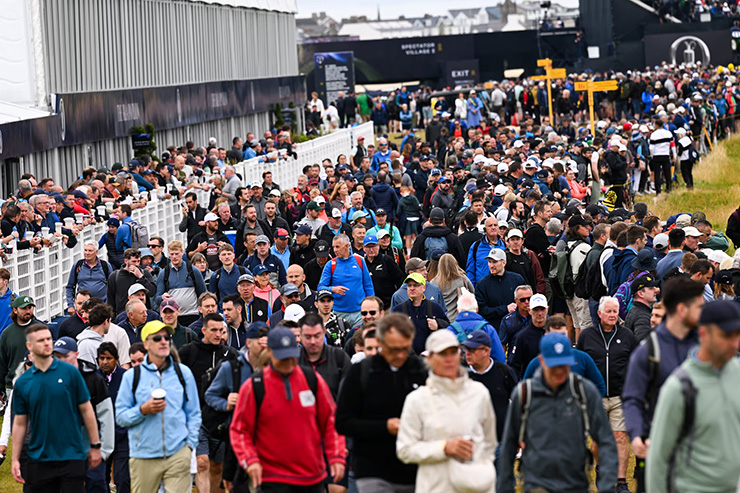
The fan village sits right of the 13th hole at the 154th Open Championship, all retail tents and corporate fortresses and vendor buggies. Rising from the open field, it’s an impressive sight, so long as you don’t think too hard about what it replaced.
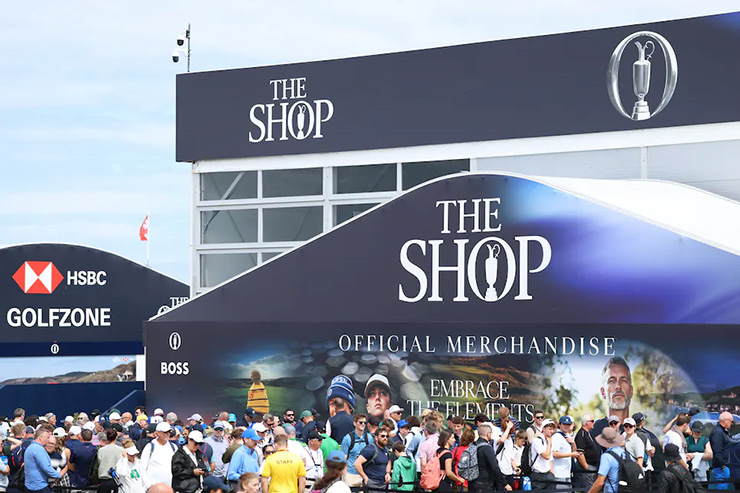
This is usually Royal Birkdale’s practice range, arguably the best in the United Kingdom, unarguably one of the coolest parts of the property. It’s the spot where Jordan Spieth spiritually fused with the ghost of Seve for 22 beautiful minutes, an episode that explains why the Spieth Experience™ still has gravitational pull long after his star stopped emitting light. Now, where Spieth’s shot cleared the dunes and vanished into the unknown, you can buy a claret jug hat for £20.
It’s one change in a wave of them at Birkdale. Each is defensible on its own. Together, they leave things unsettled. The Open, at its core, is an exercise in preserving art from a distant time. Lately, it feels like the art is being altered just to get more people through the door, compromising the very reason they came.
This isn’t a rant against commercialism for its own sake. The R&A is transparent that Open Week funds nearly everything the organisation does the rest of the year. Grassroots grants, course-access programs, sustainability research, the amateur game, women’s and girls’ initiatives. It’s money that reaches well past St. Andrews, into municipal courses with no connection to major championships. The R&A is not a private equity fund extracting value. It’s a good steward putting the money to good use. The more this week makes, the more work it can do the other 51.
That’s all well and good. It’s just that the Open guards a purity that much of the rest of the professional game waved goodbye to long ago. Players historically used the same modest clubhouse lockers. You see them walking into town for dinner, unbothered, sometimes unrecognised. Get a tee time at a neighbouring course at dusk, and you’ll find a caddie or two playing nine with a local, chasing the last of the light. Fans camp in fields a mile out and walk in at dawn. The merchandise tent, until recently, looked more like a pro shop than a flagship store. No tier system for how close to the game you were allowed to get. The competition and the people who showed up for it were the product.
For years, that was the reality. It’s still the promise. It’s just not entirely the experience anymore.
Players now get driven to holes in Mercedes courtesy cars. The merchandise area has grown to the size of a department store. The R&A, it seems, has done the math on what the Masters makes off sales like these. The grounds overflow with branded “experiences,” from whiskey to tourism, to credit cards, insurance and watch-making. Hospitality has expanded, too, tiered now into “Signature,” “Platinum,” “Premium”, and “Select,” in descending order of how close your money gets you to the game. Signature is the top of the ladder. It buys access to “Clarets,” the venue overlooking the 17th green, plus three others around the course. A reserved grandstand seat at 18. A Q&A with a past or current player. A photo with the Claret Jug. A fast track through the Open Shop. All-inclusive food and beverage. Early-bird pricing runs $1,344 for Wednesday and $3,286 for Sunday.
It’s not that these changes are being made—this is happening at all of golf’s biggest events—but how. Only the Old Course has hosted the Open more than Royal Birkdale over the last 70 years. That legacy didn’t stop the club from remaking its setup wholesale since 2017: a full redesign of the short par-4 fifth; a shortened and rebuilt par-3 seventh; the old par-3 14th erased entirely; the old par-5 15th rebuilt to become the new 14th; a new par-3 15th that shares almost nothing with the hole it replaced. Erasing the old 14th also opened ground to carve out a short-game area that wasn’t there before.
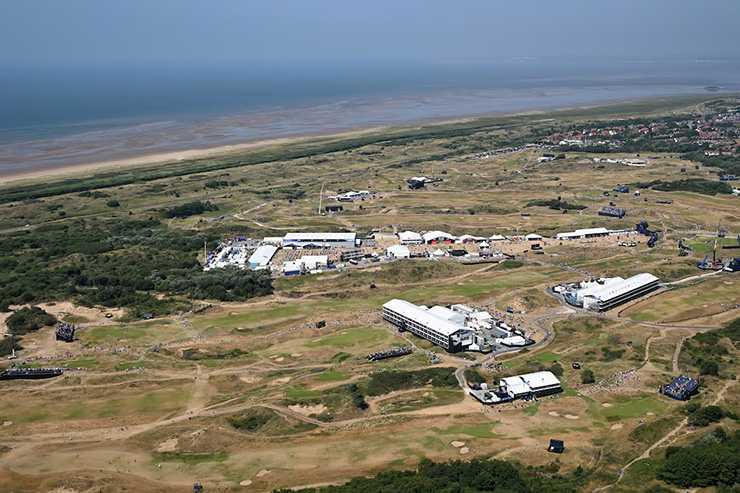
An aerial view of Royal Birkdale for this week’s Open, with the spectator village located in the club’s practice facility. Oisin Keniry/R&A
The changes collectively feel like a betrayal of what a links is supposed to be. A proper links isn’t a sequence of holes so much as a single organism. One that breathes with the land, exhales with its weather and remembers, hole to hole, what it asked of you a few holes back, the way a good novel plants a line in the opening pages and cashes it in Chapter 20. That rhythm isn’t decorative, as old Scottish and English architects walked the ground until it told them where the holes already were, and then they got out of the way. It’s the entire architectural philosophy separating links golf from the parkland style America perfected, where nothing is imposed, and everything is discovered.
Bolt three or four new holes onto that organism, built to modern spec, with modern equipment and modern crowd-flow math in mind, and you don’t get a stronger version of the same course. You get a graft that never quite takes.
Scottie Scheffler, perhaps accidentally, delivered a dagger on Tuesday, stating, “I think it’s pretty obvious … the one thing I found interesting is it’s so obvious as to which holes had been redone. They look like they’re not even on the same golf course. You look at 14, 15, 16, those green complexes, and the amount of slope that they have off of them is pretty severe and quite challenging. The fifth hole is kind of like that, and the seventh hole as well. It was pretty obvious, like, oh, these are the holes that got redone because they look like they’re on a different golf course.”
Christian Petersen
If you’re wondering why a links tracing its roots to the 19th century made changes this drastic, it wasn’t entirely for shot-making. It wasn’t for tournament toughness, either. It was for crowds, crowd flow and the bottom line. In 2017, the Open drew a then-record 230,000 here. This week, that number is expected to jump 30 per cent to 300,000 on the grounds. The math is simple: more tickets, more merchandise, more money.
In his annual address to the media, R&A chief Mark Darbon pushed back against the idea that Birkdale had bent to spectator demand. “Given the strength of partnership that we have with our host venues, of course we’re part of some of those discussions, and where there are things that we can do together that also help us operationally, they often make sense to do to help with the staging of the championship,” Darbon said of course changes he insists the members were behind. “I think it would be wrong to say that all of the changes are driven by a need to accommodate spectators.”
But is there a potential price for refusing to change? Darbon says there’s no threat to those that don’t, but Royal Portrush had to carve out two new holes to build a fan village in 2019. Royal Liverpool did the same in 2023.
And there are the current predicaments of rota courses at Muirfield and Turnberry. Both spent years on a kind of shadow probation over political entanglements—Turnberry for its ties to the Trump family, Muirfield for its no-women membership—the sort of principled stand the R&A could make and still look virtuous doing it. Now each is sidelined for other reasons. Turnberry is deemed too remote; the R&A wants new roads built to handle the traffic. Muirfield’s sin is refusing to remodel itself for bigger crowds; a smaller, more intimate footprint that once read as a virtue is now treated as a disqualifier. The 2013 Open at Muirfield drew roughly 140,000 fans, less than half of what’s expected this week. The same logic applies to Portmarnock, waiting in the wings for its own Open bid, already being told the local infrastructure isn’t ready, with not enough beds, not enough roads, fans possibly ferried in by boat.
The real test of how far this goes arrives next July, at St. Andrews, when it hosts the 2027 Open Championship. The Home of Golf is supposed to shatter this week’s attendance record, drawing as many as 30,000 to 40,000 more fans than it did in 2022. Somewhere near 330,000 people funnelled into a town of 17,000. That’s a town problem, a roads problem, a can-this-place-physically-hold-this-many-people problem. St Andrews is the source code. If the Old Course starts getting redrawn to answer to a gate number, there’s no longer a version of the Open immune from this thinking. Everything becomes negotiable once the birthplace of the game is on the table.
To be fair, the Open isn’t the only one making this trade. The Masters has spent the last decade turning its hospitality operation into an arms race, expanding merchandise revenue and premium patron packages well beyond what Augusta once tolerated. The USGA has followed a similar path at the U.S. Open, layering in more corporate hospitality tiers each cycle. The Ryder Cup, run by the PGA of America, now functions as much as a hospitality event as a competition, with ticket packages becoming controversial.
Still, is there a cost to what the Open is doing? This championship has a version of the game closest to how it was actually invented. Played over land no one built, on ground fast and cruel enough that luck and skill blur into the same thing, in weather nobody controls and nobody thinks to complain about. Every other major sells controlled perfection; the Open, historically, has sold the opposite. Not pure, exactly. But the closest thing is left. The Open’s value was never tradition for tradition’s own sake but a reminder of what this game once was and, if only for a week, can still be again.
This week, there sure feels like a lot of proverbial scaffolding.
And the thing about that is, put it up, keep it up long enough, and eventually people forget there’s a building underneath at all. They start to think the scaffolding is the attraction.
If the Open gets sanded down into something more legible for a bigger gate, it won’t necessarily have failed. Attendance up. Revenue up. Grants written, courses funded, good work done. But it will be another step away from why any of this matters in the first place. Nobody votes to kill an identity. They just keep trading slivers of it for next year’s numbers, until one day the identity is simply gone, and no one knows why it vanished. But at least you can buy a hat at the spot where the identity once lived.
MORE GOLF DIGEST OPEN CHAMPIONSHIP COVERAGE
Everything you need to know about this year’s major at Royal Birkdale
The Open Championship is not called “The British”
Here’s the record payout for each golfer at Royal Birkdale
After hitting the opening tee shot at the U.S. Open, James Nicholas qualifies
Here’s everybody in the field (so far) at Royal Birkdale
Follow Golf Digest Middle East on social media
Main Image: Warren Little


