
 AR
AR
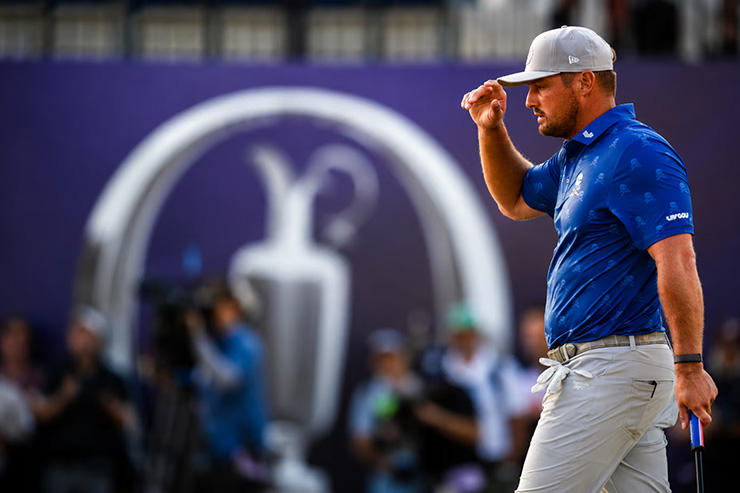
How do you begin to solve a problem? The answer is first, you have to start somewhere.
That is the unenviable situation that the governing bodies, particularly the R&A and USGA, find themselves in all too often. And ultimately, it was at the heart of the drama surrounding Bryson DeChambeau and the two-shot penalty he was assessed on Friday night at the Open Championship.
For those just tuning in, DeChambeau birdied the 17th and 18th holes of his second round to vault him, at the time, to one back of Lucas Herbert’s 36-hole lead. Unbeknownst to him, a video from the fifth hole would change everything.
That video showed, in the eyes of many, the two-time U.S. Open champion taking too many exaggerated steps behind the ball, flattening the fescue around his ball and in the area of where he’d soon taking his backswing. It’s there that the R&A, upon seeing the video, had its questions.
RELATED: Sunday’s final-round pairings at Royal Birkdale
Nothing about it looked particularly out-of-place or egregious in the modern game. On the contrary, it all looked relatively normal. Many players routinely pull tactics like this from rough lies:
• They pull a fairway wood they may have no real intention to hit, place the clubhead behind the ball before choosing an iron, then return the new clubhead to a patch of matted-down rough.
• They may perhaps step closer to their ball than usual, which has the same effect.
As recently as last month’s U.S. Open, fans questioned whether Wyndham Clark, making practice swings in unusual spots during the final round, made his fescue recovery shot easier.
But the normalcy of it all, particularly on the PGA Tour, is precisely the problem. This isn’t supposed to be normal.
In fact, there’s an exact rule to prevent it.
Rule 8.1 explicitly prohibits “moving, bending or breaking” any growing natural objects. Players can’t press down or alter the surface in any meaningful way. It’s like driving a little over the speed limit. It’s not allowed, even though most who do it get away with it, if you are seen doing it, authorities have the right—perhaps even the responsibility—to look into it.
In part, that’s what the R&A did here. Now, would it have been better has officials explained publicly more about what happened, how they became aware of it, what DeChambeau argued as he discussed the matter and how they ultimately decided that the penalty was needed? Sure. Still, officials had every right to investigate and adjudicate the matter, as part of their responsibility to protect the entire field.
Bryson DeChambeau has been assessed a two-stroke penalty under Rule 8.1 on the 5th hole, meaning his score for round two is a 68 and he is five-under heading into the weekend. pic.twitter.com/HsvgA3iSqY
— The R&A (@RandA) July 17, 2026
The issue of enforcement isn’t the R&A’s problem. It’s golf’s problem, and by not enforcing it more regularly, the situation becomes a host of grey areas. Standards don’t stop slipping by themselves, though. For every rule that goes unenforced, the next one down starts bending. The line has to be drawn somewhere, and on Friday, the R&A drew it at 2026 Open Championship contender Bryson DeChambeau.
On an individual level, it’s incredibly harsh. Put yourself in that situation, and you’d see why:
Why am I being selected for punishment now for something that everybody does all the time? There’s probably somebody on the other side of the course right now, without the unfortunate luxury of having three different cameras examining every move I make, doing exactly this. Why me? Why now? Why for this?
If it were me, it’d feel like selective enforcement, too.
Bryson DeChambeau has received a 2-shot penalty for improving his lie on the 5th hole.
Live From The Open is breaks down the incident now on Golf Channel ⬇️ pic.twitter.com/aktl1kK8dv
— Golf Channel (@GolfChannel) July 17, 2026
I can only suspect that this is the R&A using the situation to clamp down on this tactic more broadly. An explicit shot across the bow, screaming that this norm, despite there being “no intention” of ill intent by the player, is simply not allowed. The countless examples of others doing exactly the same and escaping without punishment are a thing of the past.
For golf to hold true to that promise, the task now falls to the various tours. Their lack of enforcement on a day-to-day basis on all manner of edge cases—from lie improvements to club throwing, slow play and equipment regulation—is how slopes like these become so slippery. Players’ habits, good and bad, are formed on their home tours.
All too often, they’re left unchecked. Then they arrive on the game’s biggest stages and are confronted with a new reality. Things as they should be, not as they usually are. The R&A drew a line on Friday. It’s the tour’s job to hold it.
The specifics of when to un-normalise something will always feel unfair to the player bearing the brunt of it. Bryson DeChambeau has the right to feel hard done by in that respect. But the fact remains the same.
To fix a problem, you have to start somewhere.
• • •
MORE GOLF DIGEST OPEN CHAMPIONSHIP COVERAGE
Everything you need to know about this year’s major at Royal Birkdale
The Open Championship is not called “The British”
Here’s the record payout for each golfer at Royal Birkdale
After hitting the opening tee shot at the U.S. Open, James Nicholas qualifies
Here’s everybody in the field (so far) at Royal Birkdale
The decision tour pros face as they stand on the tee at Royal Birkdale
The Open keeps growing. But is it coming at the price of tradition?
Follow Golf Digest Middle East on social media
Main Image: Supplied


