
 AR
AR
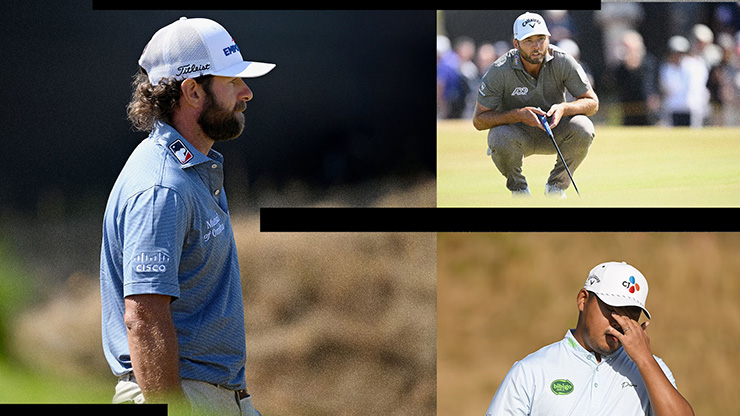
The great and painful rule on days like these is that everyone has to fall. They’re raindrops on a car window, waiting for gravity and accumulating pressure to send them cascading out of sight. It’s a thing that happens gradually for the field but suddenly for the lone player, and on certain Sundays, like the Sunday we just saw, things are so tight and so confusing that you can’t predict exactly when anyone will go. If you try, you’ll be wrong.
For instance: When I left the media centre early in the afternoon, Tommy Fleetwood was ascendant. He’d just made birdie on eight, and I figured to catch him on ten green. I hardly needed to look at the signs for 10 tee, 10 fairway, 10a fairway crossing, etc., because I could have closed my eyes and followed the shouts of “Tommy!” It’s their favourite word, and their second-favourite is the one they tack on, “lad.” I followed the vocal energy force and arrived just in time to see him miss a 10-foot par putt. Jinx, I thought, but several other reporters informed me that no, in fact, they were the jinx, not me, because they’d caught him on nine, and he bogeyed that one too. Then he made bogey on 11, walked to 12 tee bent into the breeze, face set in what looked like grim defeatism, and two pars later, it was clear that if you were interested in following the winner, you’d better find a different horse.
Tommy fell.
RELATED: Here’s the record payout for each golfer at Royal Birkdale
Bail out, then, and back to 11, where Sam Burns and his playing partner waited on the tee, peering into the fairway. The herring gulls were thick in the air, circling like white beacons of hope or flesh-craving vultures, the wind threatened to get serious, and the leaderboard proclaimed the new king, Si Woo Kim. All alone, 10 under.
“Man, look at Si Woo.”
“Si Woo could do this.”
“Si Woo could run away with this.”
A memory: Thriston Lawrence, Troon, two years ago, around the same time and on the same day, also destined to win.
In the distance, Si Wood made bogey, and then again, and slipped rather than fell, but slipped precipitously. A ghost remained: Cameron Young, no longer on the course, but now solo leader, now haunting a Birkdale that suddenly seemed less vulnerable. Other innumerable and ancient ghosts had been beckoned to protect its regal dignity, and all of a sudden it became the kind of place where you can shoot 8 under for one round, but you can’t shoot 11 under for four.
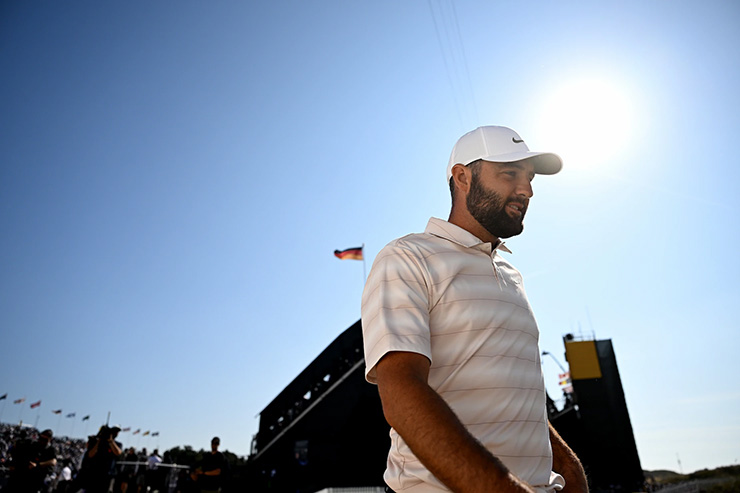
Oisin Keniry/R&A
Walking with Burns and his playing partner, we had to live vicariously through Steve, the media liaison clad in the standard-issue black kit emblazoned with the gold Hugo Boss label, who shepherded us through the dune paths and brought us breathless news from the radio in his ear. This is where we learned that Scottie Scheffler had endured some TIO rules fiasco on 17, but made birdie anyway, and now needed to chip in on 18 to tie Young. That seemed promising—at least he didn’t have to putt it—but he missed.
Scottie fell.
Pretty good, I thought, to fall so late after a week of frustrations. He outlasted Jackson Suber, and Rasmus Neergaard-Petersen, and Ludvig Aberg. He outlasted the messy sad shambolic circus named Bryson DeChambeau. All of them fell before we had time to collect our thoughts, who fell fast enough that we wondered if they were really there in the first place.
What to make of Sam Burns? There is something maddening and heartbreaking, down in the narrative churning centres of the brain, when a player who has had famous difficulty under pressure seems to be improving slowly but steadily, getting closer and closer, until the moment arrives when he’ll stick the blade into the black heart of every demon…except he just does the same thing he’s always done. Burns had become intensely sympathetic to me after Shinnecock, and it felt like this victory was deserved. That word, “deserved,” is loathed by the spirits who govern these results, the little impish minions of Old Tom Morris or whoever, but still, I wasn’t wrong, he deserved it.
He couldn’t make birdies. When he saved a brilliant par on 13, I wrote down the all-caps word “MOMENT” in my notebook, dully registered that his playing partner made birdie, and waited for things to change. They never did. And while they were never changing, somewhere off in the nebulous up-ahead:
Ryan Gerard fell.
Lucas Herbert fell.
They fell quietly, in the way they seemed destined to fall, with never more than a passing thought that inside them they had the capacity for NOISE.
RELATED: Watch Ryan Fox’s incredibly clutch winning birdie putt
Invisible Cam Young rose in the imagination, inflated to ten times his size and strength. He drew in his mighty breath and exhaled like bearded Aeolus, fearsome to behold even as a name on a board.
“Wouldn’t you take Young’s score now?”
“And he should be at 10!”
The playing partner of Sam Burns stopped in the portable toilet after the 13th hole, and we had to wait for him to finish before they’d let us cross the footbridge to the 14th tee. We joked, in our stupid, tired way, about asking him after the round what words of motivation he gave to himself inside the dark, humid, stinking cauldron.
And what about the mood? A little sleepy, for a major finale, but pleasant and cool, and beautiful. Around and underneath thousands of people, the land maintained its serenity. But a layer below that, if only in my head: something mischievous. Some story still to be told.
Now it was a play with few characters, the other principles having been killed off. It’s easy in moments like these to fall into the trap of thinking that nobody was rising to the occasion, but the scene on the ground urges caution. When one or two fail to rise, it’s a story of personal failure. When everyone fails to rise, it may just be that it’s really hard to rise.
Still, you can detect an allergy to the lead even when the reaction isn’t anaphylactic. Kim stood alone for a moment, bogeyed twice to ease the pressure, and never wanted to go back, at least on this day. On 16, he blew an approach from 155 yards, made bogey, and dropped to 7 under. The grip on possibility slackened. But when the 12-foot birdie attempt on 17 slid past, another door closed.
Si Woo fell.
As we waited for the Burns birdie, in the deep recesses of the subconscious, the emergence of a possible parallel: his playing partner faced an impossible bunker lie, hacked out at a horrendous angle, but saved bogey to great applause. He appeared—and later admitted he was—energised. Did it not seem like something we’d seen before, on this course? Yes: 2017, Jordan Spieth, hitting from the driving range on 13, saving a miraculous bogey, and electrifying himself right to a Claret Jug. The gods of England love a plucky defence under impossible conditions. They love a Dunkirk in miniature. He’s their chosen soldier now.
But forget the flights of fancy, the rational voice said: You’ve gone hallucinatory. Even when the man made birdie on 16: Calm down.
The birdies never came from Sam Burns. Everything precise and clinical about his game deserted him, and all he could give himself on the par-5 17th was 32 feet for birdie. Some people think he’s the best putter in the world, but under the gun, he never quite looks like it. And once that chance went begging, the birdie he needed on 18 felt like a dream too far—out of 76 players that day, only four had done the job, and those four didn’t carry this weight.
On the tee, roughly 40 black-clad “player escorts,” who, it was whispered, were all former military, gathered to protect the final two players from the crowd’s imaginary assassins and psychopaths. There were identity checks for the media, large white ropes, blue metal boundaries, and beyond them all, a group of people who had distinguished themselves all week as the world’s ideal spectators. Hell, even the Americans osmosed the simple dignity, fell in line.
Burns, to his credit, kept the faint flames flickering until the last 28-foot putt rolled through the 72nd green. But beneath fluttering banners and the resolute sun, it just couldn’t happen.
Sam Burns fell.
We had been discussing the playoff for some holes. Was it three holes or four? Was it the PGA that was four? Didn’t the Open used to be four? And where would it start? We pointed out the 14th tee to each other. The others said goodbye to those of us who didn’t have the proper credentials to join the proliferating army of mercenaries on the green. But someone who knows when rules should be bent, just a little, had let us climb a dune by the grandstand and look on from afar. We saw it clearly:
The final putt fell. Cam Young fell with it.
And all that stood was the exception—the exception to the great and painful rule.
• • •
MORE GOLF DIGEST OPEN CHAMPIONSHIP COVERAGE
Everything you need to know about this year’s major at Royal Birkdale
The Open Championship is not called “The British”
Here’s the record payout for each golfer at Royal Birkdale
After hitting the opening tee shot at the U.S. Open, James Nicholas qualifies
Here’s everybody in the field (so far) at Royal Birkdale
The decision tour pros face as they stand on the tee at Royal Birkdale
The Open keeps growing. But is it coming at the price of tradition?
R&A CEO says Bryson penalty was ‘clear cut’ rules decision, no call from Trump
Follow Golf Digest Middle East on social media
Main Image: Supplied


