
 AR
AR
Joe Dean stood 10 yards away, trying to get up-and-down from a greenside bunker to become the final golfer into the Open Championship field. But the man in the white shirt and straw hat wasn’t watching him. He was looking instead down the 18th fairway, having just emerged through the amphitheatre beside the Royal Birkdale clubhouse, a chute where the course opens like a theatre curtain raising. He either didn’t know he’d stumbled into the middle of the championship’s Last Chance Qualifier, or didn’t care, or had cared once and stopped the moment the sight hit him.
“Oh my God, it’s so brown!” he said, perhaps to no one, or everyone. Maybe only to himself. The grandstands, nearly full for a Monday qualifier, gave Dean a healthy ovation when he saved par to win the inaugural event. The man never turned around. “So, so brown,” he said again. “It’s beautiful.”
At the risk of overreaching on the first working day of a major week … well, he’s not wrong.
For all the aesthetic gifts this game produces—and the yellow Open boards stacked atop blue grandstands, kissing a blue sky, are chief among them—there is something almost illicit about a chase for a claret jug playing out over bronze and gold and what little green grass remains. Mainly, for what that look means.
“Forged by Nature.” Three words, plastered on every billboard and grandstand and awning across the property, the way they have been at other Opens before this one. Not so much a slogan as a compass. This is golf as it existed before anyone thought to improve it, no artifice, no human hand smoothing the edges, nothing between a player and the ground but whatever the ground decides to give. The promise is that the R&A plays the course the land hands them.
The hope, less spoken but no less real, is that when the weather turns mean, the course turns meaner with it. That hope hasn’t been fully answered in years—2018, Carnoustie, is the last time the Open truly burned. But a summer without much rain has baked Birkdale’s fairways to the hardest they’ve been since.
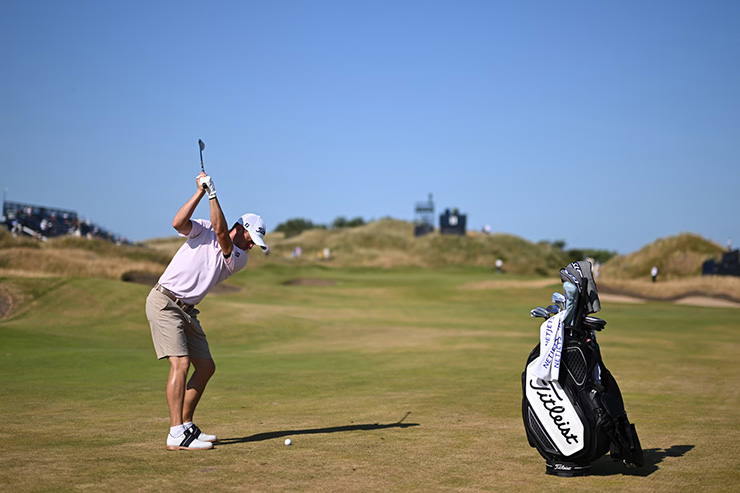
Links golf, at least when it’s like this, has a register the manicured, colour-corrected version of the sport lacks. Modern professional golf has become an exercise in inputs and outputs. Launch angle, spin rate, strokes gained/off the tee, a hundred decimal points standing between a golfer and the illusion that this game can be solved. Bring that golfer to Birkdale in these conditions, and the arithmetic stops mattering. A 330-yard drive loses its appeal the moment it meets a downslope and skitters into rough nobody accounted for; a beautifully struck iron means nothing once it lands, checks up out of habit, thinks better of it, and rolls on into a bunker 40 yards past the pin. The ground has its own convictions, and it is indifferent to what the Trackman said on the range. “When it’s firm like this, it can be even more so downwind. Five-irons are running out to 300 yards. You have to be careful because they put bunkers right at that number before the dogleg on half the holes,” said Jordan Spieth, who won the Open the last time it visited here. “It’s important to get over here and really get your distance control, the total distance control dialled in. It’s firmer around the greens, making it more difficult. We can’t … some of us who like to use, like myself, a 60 degree and fly balls and spin it a lot, those shots are a lot harder when it’s firmer around the greens. It can bounce into it a lot more easily. You have to be super precise.”
Stuart Kerr/R&A
What links golf asks instead is the capacity to see a shot that doesn’t yet exist, to improvise outside lines that, most weeks, these players never even have to acknowledge. American golf, private-club golf, the golf most of this field learned the game on, rewards certainty. Hit it here, it stays here; land it there, it stops there. Links golf revokes that certainty on principle. It’s why accomplished ball-strikers arrive at an Open and leave bewildered, and why players most of the world has never heard of find themselves in weekend contention. It is a test of imagination as much as nerve, since trusting a shot you cannot fully govern, round after round, demands a courage that has less to do with what a player can do than whether he’s willing to do it.
Here, greens are called greens because they are the only thing on the property still entitled to the word. Everywhere else—the fairways, the rough, the heather climbing the dunes—has burned down to a brownish-yellow that looks, feels, and plays like cast iron. On Monday afternoon, a handful of caddies near player services floated a claim that by the weekend the fairways might be running faster than the greens, which compounds the problem. Holding a green from the fairway is difficult enough; from the fescue, it is nearly impossible. The whole sequence unravels backwards from the tee shot.
Players have already taken to social media to show their ball bouncing across fairways, gleefully calling it the firmest they’ve ever played. Viral catnip, sure. Doesn’t make it any less true, especially with hot temperatures, little rain and more sun expected in the forecast.
Because the Open is played on the ground more than in the air, it’s tempting to think the wind matters less this week. The opposite is closer to true. Is it helping or hurting? Is it doing both at once, lifting a shot on one side of a dune while shoving it sideways on the other? Answering that, hole to hole, shot to shot, is its own separate skill, layered on top of everything the ground is already demanding. And the ground demands plenty. Somewhere in the neighbourhood of 120 bunkers scattered across this landscape, sod-faced and deep enough to swallow a stance, arranged less like hazards than punctuation marks. Reminders that this version of golf was never meant to be fair.
This isn’t chaos, either. Seven of the 12 players in Monday’s last-chance qualifier broke 72, Dean topping the group at two-under 68. It’s proof that the ground rewards good golf that cooperates with it rather than resorts to combat. The man in the straw hat was right. This is beautiful, because the course has been tipped in patina, proof Royal Birkdale will shed modern manners this week to see which players still remember what this game once was.
MORE GOLF DIGEST OPEN CHAMPIONSHIP COVERAGE
Everything you need to know about this year’s major at Royal Birkdale
The Open Championship is not called “The British”
After hitting the opening tee shot at the U.S. Open, James Nicholas qualifies
Here’s everybody in the field (so far) at Royal Birkdale
Follow Golf Digest Middle East on social media
Main Image: Thananuwat Srirasant


