
 AR
AR
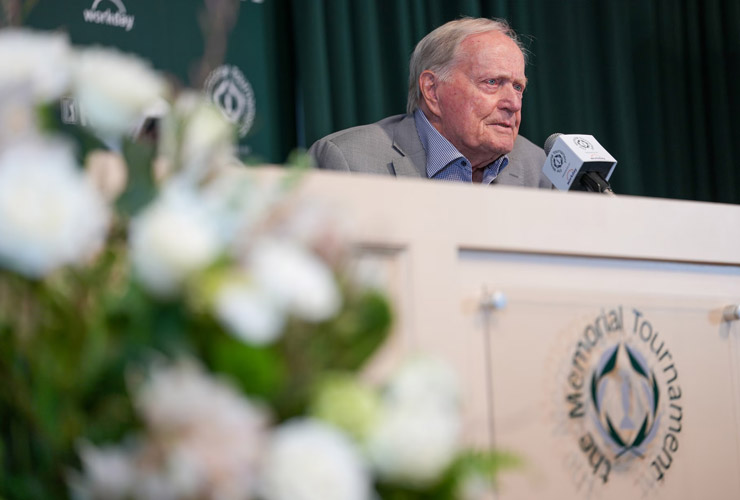
Jack Nicklaus has only a rudimentary understanding of what the PGA Tour intends to do with changes to its schedule in the coming years. What he does know, though, is what kind of schedule worked for him throughout his career and already sees that a slate packed with big events and major championships is not in the best interests of the players or the game.
Never one to hesitate to offer his opinion on the game he once dominated and to which he still is involved as host of the Memorial Tournament, Nicklaus said Tuesday at Muirfield Village Golf Club that he is “not exactly in favour of what they’re doing right now.
“I mean, I hate to see tournaments bunched too much together with too many big tournaments too close together,” he said. “That’s a problem, I think. And I think that’s going to be a problem for the tour in the future.”
The Memorial, which Nicklaus created in 1976, celebrates its 50th anniversary this year and the limited-field signature event comes three weeks after the PGA Championship and two weeks before the U.S. Open. Two signature events, in Miami and Charlotte, N.C., preceded the PGA at Aronimink in Philadelphia. Another signature event in Connecticut follows on the heels of the U.S. Open at Shinnecock Hills in New York.
A similar crunch occurred in February and March with just one “regular” event, the Cognizant Classic in Palm Beach Gardens, Fla., squeezed between two signature events in California before and the Arnold Palmer Invitational and the Players afterwards.
“I probably shouldn’t have brought it up,” Nicklaus, 86, said with a chuckle. “I’ll get chastised for that later. Anyway, I think it’s harder for your tournaments to stand out. I mean, if you looked at the schedule, we’re involved in the Cognizant down in Florida [the Nicklaus Children’s Health Care Foundation is the charitable beneficiary]. And we have Pebble Beach and Los Angeles, Tiger’s event, and then Cognizant, and then we had Bay Hill and The Players. I mean, what chance does that tournament [Cognizant] have? I mean, it sits right in the middle of those. They don’t have a chance.”
Nicklaus positioned the Memorial from the start as an event that would stand out in the schedule, offering a quality test of golf on a well-conditioned course and striving to treat players better than at any other tour stop. He also offered an event with a unique theme, honouring the greats of the game and other figures who contributed to golf.
Today, it’s difficult for a tournament to differentiate itself from others, but that’s not what the Hall of Fame legend worries about; the Memorial is still a premier event with a $20 million purse. Nicklaus is more concerned about the pressure on the players to continually bring their best to every event and the challenge in doing so. That affects them in several ways and potentially compromises the quality of the competition.
“It’s hard for the players to really be focused to play that much and be on top of their game. And that, to me, is … I look at it from the way I was as a player. I could play a couple weeks in a row, maybe three weeks in a row, but I needed some time off to be able to recharge the batteries. And I think everybody needs to recharge their batteries.
“But if you have so many tournaments back-to-back, first of all, you’re going to give a guy an opportunity to have an injury because you just can’t play that much. And the quality of your play is not going to be as good. You want the guys to be able to have their best quality of play every time they play.”
Nicklaus continued by noting how he liked to spread out his starts. “I tried to pace my schedule and I played two weeks, maybe sometimes three. I felt like it worked that way. But I’ve never [played] more than that. I don’t think I ever played more than three weeks in a row. And because your efficiency leaves you, your desire leaves you. You get burnt out. You get stale. That’s what you don’t want. And that’s what I worry about. I worry about that, not from the tour standpoint, but from a player standpoint. Big difference.”
PGA Tour CEO Brian Rolapp is making himself available to the media Wednesday to perhaps shed more light on what the tour is planning in the coming years. He laid out broad ideas at the Players in March and said there would be more specifics coming in June during the week of the Travelers Championship. Nicklaus hopes to sit down with Rolapp and commissioner Jay Monahan to get a better handle on the subject and what it could mean not only for his event but for the tour he helped create in 1968 when the touring pros broke from the PGA of America.
If anyone understands and can appreciate the growth of the PGA Tour, it’s Nicklaus.
“The players wanted to control their own destiny more,” Nicklaus said, recalling the period in which he, Gardner Dickinson and Arnold Palmer were the leaders in the movement to create a tour separate from the PGA of America. “Arnold and Gardner and I were on the board and we were the ones that … broke away from the PGA of America and formed what was then the ATP I think we called it, Association of Tournament Players. And we hired a fellow named Sam Gates as an attorney to put that thing together. We then hired Joe Dey as our first commissioner. And the tour’s just grown from there.
“Probably fortunately, I haven’t been in the middle of it and know exactly what’s going on, … but I think that the PGA Tour is probably the healthiest it’s ever been. I think it’s doing well. The players are, I mean we got a great group of players, it’s an international game. I’m proud that back in 1968 we were able to start something that’s gotten to this point.”
Follow Golf Digest Middle East on social media
Main Image: Ben Jared


