
 AR
AR

The PGA Tour, through the work of the Future Competition Committee, spent roughly nine months studying the sport’s structural problems, and on Tuesday it introduced its solution. Starting in 2028, the tour will look fundamentally different with two co-existing series, real promotion and relegation, a reimagined postseason and a schedule built around markets the tour has mostly ignored. A number of details remain unresolved—most notably a specific schedule and which tournaments are part of which series—but the broad architecture is set, with CEO Brian Rolapp set to elaborate during a press conference at the Travelers Championship.
Here are 15 things you need to know about the tour’s new future.
Two tours, one ecosystem
The tour isn’t splitting so much as stratifying. The PGA Tour Championship Series will replace the elevated/signature events model, while the Challenger Series runs concurrently as its feeder. They share a calendar but nothing else, with separate fields, separate purses, separate points systems. The old world had one tour with varying tiers of consequence depending on the week. The new world draws a hard line: elite competition on one side, the path to it on the other. The intent is clarity, for fans, partners and players alike. Everyone should know what tier they’re watching and exactly what’s at stake.
A letter to fans on the future of the @PGATOUR. pic.twitter.com/WAFJwFEV7y
— Brian Rolapp (@brianrolapp) June 23, 2026
The best players will only play each other
Championship Series members are ineligible to enter Challenger Series events. This is the central premise of the entire restructure. No more stars cherry-picking schedules, no more diluted fields at marquee events, no more weeks where the best player in the field is ranked 40th in the world. The tour has tried to solve the problem of elite field consistency for years through elevated events, designated events and signature events, each iteration a variation on the same incomplete answer. There could still be issues: Does this prevent a star from playing a hometown event, or a countryman playing his national open? Still, it is the first structural solution; membership itself determines your schedule.
The Championship Series is lean and lucrative
Roughly 23-24 events per season, running February through August. Fields capped at 120 players with 36-hole cuts and no alternate list. Purse floor of $20 million per event. The schedule includes the majors, Players, Ryder Cup and Presidents Cup. Everything else gets negotiated fresh as the tour is openly shopping markets it hasn’t prioritised, optimising the schedule around major championships and building in off weeks at regular intervals. The Championship Series is designed to feel like a season-long championship, not a collection of disconnected tournaments.
RELATED: Brian Rolapp to succeed Jay Monahan as PGA Tour commissioner
Sponsor exemptions are finished
The exemption economy that allowed title sponsors to place preferred players in fields regardless of merit is over. This is a significant cultural shift for a tour that has long operated on relationships and accommodation. The field will be determined entirely by performance. Whether that removes a meaningful revenue lever from sponsor negotiations is a question the tour will have to answer.
The postseason is being reinvented
The Tour Championship will feature match play, rotate across prestigious venues—many of which the tour has never visited—and carry formal retention and relegation implications. The season-long points leader will receive specific recognition. Format details are still forthcoming, but the direction is a deliberate departure from the stroke-play, same-venue model at East Lake that has defined the postseason for years. Match play at the tour’s season finale is a significant swing—the format is inherently unpredictable, which cuts both ways. The best player in the world might lose on a Wednesday. That’s a feature to some, a flaw to others. What’s not in dispute is that the current postseason model has failed to generate the cultural moment the tour needs to close its season.
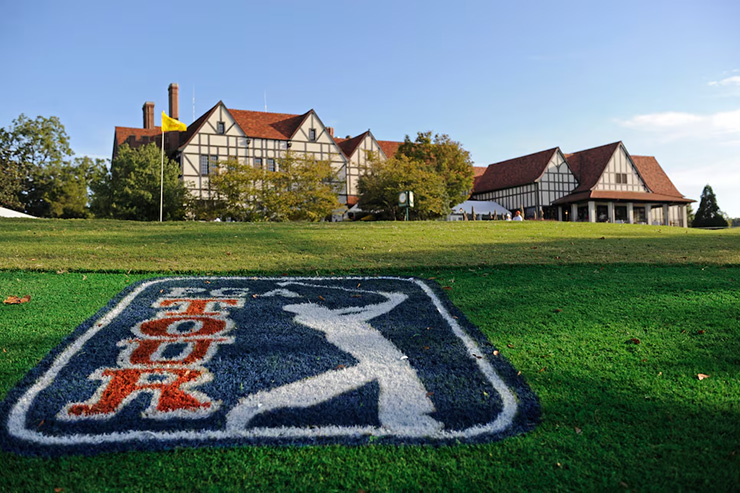
The Tour Championship will rotate venues rather than have a permanent home at East Lake Golf Club in Atlanta. Chris Condon
The tour is going after new cities
Boston. Denver. New York. Philadelphia. San Francisco. Seattle. Washington, D.C. The tour listed those markets explicitly as Championship Series targets. The message is that the sport’s premier series belongs in the country’s biggest rooms, a departure from decades of schedule inertia built around sponsor relationships and geographic convenience. For years the tour’s calendar reflected the history of who wrote the biggest check. The new model reflects where the audience actually lives.
The fall goes international
Once the Championship Series wraps, a limited series of elevated international events will feature top-tier players in partnership with the DP World Tour under the existing Strategic Alliance. The intent is a genuine global footprint for the sport’s best—not the informal fall schedule that has functioned as an afterthought for a decade. The DP World Tour partnership is doing real structural work here, providing infrastructure and markets for events the PGA Tour couldn’t easily stage on its own. Whether top players participate voluntarily or whether participation becomes an expectation is a detail the tour hasn’t fully resolved.
The 90/20 rule is the engine
Each season, 90 players are retained on the Championship Series based on their points finish. Twenty players are promoted from the Challenger Series. Finish 91st or worse and you’re relegated. The math is clean and the consequences are real. For the generation of players who have known only a league that protects its members through a web of exemptions and pathways, this is a different kind of pressure entirely.
RELATED: The PGA Tour just reinvented itself. It was long overdue
There’s a safety net, but it’s narrow
Relegated players aren’t sent straight to the Challenger Series. They get one shot at a “last chance” domestic series of four to six fall events, with a limited number of Championship Series spots available for top finishers. Miss it and you’re in the Challenger Series the following year. The mechanism exists to soften the blow of a bad season without eliminating the consequences of one.
What to make of the Challenger Series?
Rory McIlroy called it a “glorified Korn Ferry” last week, and the tour will have to prove him wrong. The structure: minimum 20 events, 144-player fields, purse floor of $4 million, played largely at venues that previously hosted tour events. Approximately seven Challenger Series events will be scheduled during Championship Series off weeks and elevated in terms of consequence, exposure and benefits. The tour is investing real money in making the second tier worth watching as the purse floor is higher than the current Korn Ferry purse structure, and the venue quality is a deliberate signal. But McIlroy’s scepticism reflects a real concern: A series is only as compelling as the players in it, and the players in it will be defined largely by who failed to stay in the series above it.
The Challenger Series has a fast track
Win twice on the Challenger Series in a single season and you earn immediate promotion to the Championship Series with status for the following year. It’s one of the few explicitly defined escalators in the new structure—a clear incentive that rewards performance over seniority and gives the lower tier genuine stakes beyond mere survival. The two-win threshold is deliberately high, designed to identify breakout talent rather than reward steady accumulation. A player who wins twice in a Challenger Series season has announced himself. The tour wants that announcement to mean something immediate.

Tiger Woods was in attendance during Brian Rolapp’s introductory press conference upon taking over the PGA Tour CEO post last summer. Tracy Wilcox
Tiger Woods built this
Woods chaired the nine-member Future Competition Committee, formed in August 2025, which included Patrick Cantlay, Maverick McNealy, Keith Mitchell, Adam Scott and Camilo Villegas as player representatives, plus business advisors Joe Gorder, John Henry and Theo Epstein. Despite taking a step back following a car crash and subsequent DUI arrest, Woods was heavily involved in the process. Rolapp drove the process operationally, but Woods’ name and credibility were central to its legitimacy.
The developmental pyramid remains
The Korn Ferry Tour, PGA Tour Americas and PGA Tour University will remain in place in some fashion, all explicitly acknowledged as critical to the system’s long-term function. The tour envisions a fully integrated competitive ladder with formal votes on the developmental tier coming later this year.
Q-School survives
An annual Qualifying Tournament will continue feeding access across the ecosystem—into the Challenger Series, the “last chance” series and the developmental pathways. Eligibility and benefits details will follow later this year after board approval. Q-School’s survival signals the tour’s intent to keep traditional entry points intact even as the upper structure is rebuilt around them. For players outside the system entirely, the path still exists.
A lot of this is still being written
The boards approved a framework. The details are still being finalised ahead of a 2027 deadline. Complete eligibility criteria, including access for the DP World Tour as part of the Strategic Alliance and PGA Tour University, must be resolved before the 2027 season begins. The tour has committed to a direction. The distance between a compelling structural vision and a functioning competitive ecosystem is where most ambitious sports reforms go to die. Whether the execution matches the ambition is a question that won’t be answered for some time.
Follow Golf Digest Middle East on social media
Main Image: Supplied


