
 AR
AR
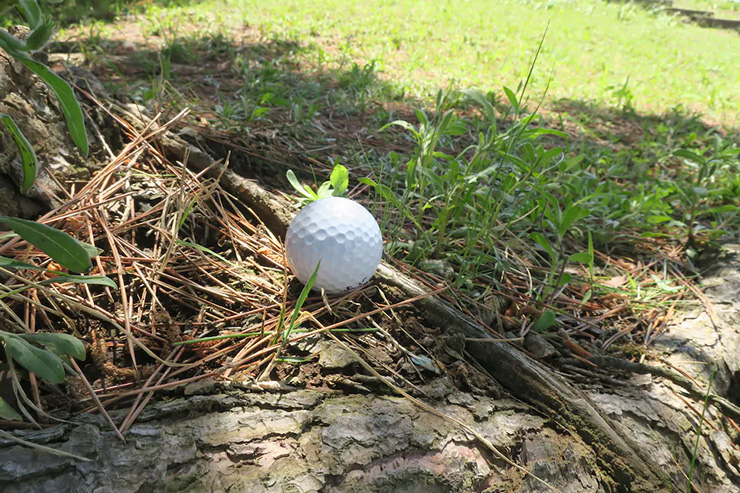
There are the guys and gals who get paid to play golf, and then there’s the rest of us. That might be oversimplifying this a bit, but when it comes to hitting a shot off or next to a tree root, the decision to try definitely boils down to motivation.
Damage to clubs, wrists, elbows—even the poor tree itself—have to be taken into consideration. Is it really worth it? For Tiger Woods at the 2015 Masters, it was. Remember his famous quote after striking a root on the ninth hole (below)? “A bone kind of popped out and the joint kind of went out of place,” he explained. “But I put it back in.”
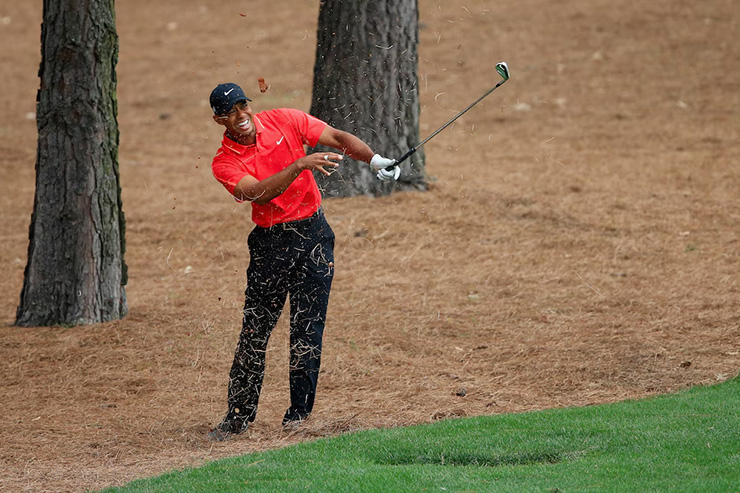
David Cannon
He really said that.
Golf’s mantra of “playing it as it lies” is often put to the test, but what happens when your ball might be impacted by ground under repair? Let’s take a closer look.
For starters, ground under repair is typically, but not always, marked in some way by a course or committee (paint, stakes, signs, etc). You might encounter a hole dug by the maintenance staff or a bunch of leaves piled for removal that isn’t marked. Doesn’t matter, it’s still considered ground under repair. Holes dug by most animals fall into this category, too.
If your ball is touching the boundary or inside it entirely, you are entitled to one club length (not two) of free relief away from GUR that is no closer to the hole. Same goes for your stance or swing if it would come into contact with GUR. You get a free drop if the GUR is not on the putting green. If there is GUR on a putting green, you also get free relief if it’s on your line of play. Just remember that you place the ball in the relief spot. Don’t drop it like you would if it were off the green.
You also can play the shot as it lies, but you’re probably not going to get a Christmas card from the superintendent if you do.
Now here’s the part of ground-under-repair relief you might not know: Any tree or plant that is rooted inside the GUR is considered part of the area that would entitle you to free relief. That includes any part of the tree or plant that extends up and outside the boundary (think of a tree branch).
But here’s the catch: “When [an] object is attached to or below the ground outside the edge of the defined area, such as a tree root that is part of a tree rooted inside the edge,” you do not get relief from it. You can take an unplayable lie, but that comes with a one-stroke penalty.
Still and unplayable might be the best option if you don’t want to find yourself saying something like, “A bone kind of popped out and the joint kind of went out of place. But I put it back in.”
MORE GOLF DIGEST RULES REVIEWS
My opponent drove in front of me and I hit his golf buggy. Who gets the penalty stroke?
Can you be penalized for playing music on a golf course?
Our match is going to extra holes
My ball is just outside a ‘no play zone.’ Can I stand in it to hit my shot?
Can I use a long putter when measuring my relief area?
I’m hitting a 6-iron on a par 3. Can I use my driver to measure the teeing area?
Can you hit a provisional ball after hitting a shot into a penalty area?
My opponent took a generous drop after hitting into a hazard. Can he be DQ’d for that?
Can I clean mud off my golf ball while playing a hole?
Can you repair divot holes or pitch marks in your line before hitting a shot?
I just played the wrong ball. What do I do now?
You’re playing a Titleist. Two holes later, it’s a Callaway. Is switching golf balls mid-round allowed?
Can you be penalised for putting tape on a golf glove? Actually …
My opponent’s ball is in my peripheral vision. Can I ask him to move it?
I knocked it stiff on a par 3 and didn’t putt it. What score do I put down for my handicap?
Follow Golf Digest Middle East on social media
Main Image: oisobach


