
 AR
AR
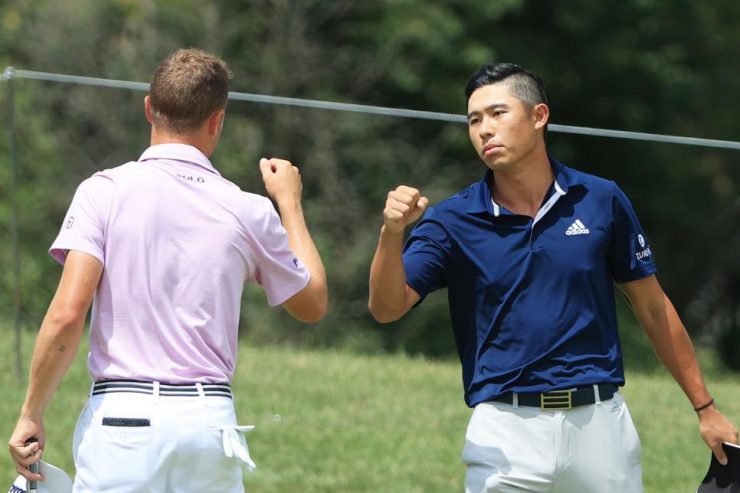
With just two weeks remaining until the U.S. Ryder Cup roster’s six automatic qualifiers are locked in, and one more after that until the captain’s picks are made, who exactly will be representing the red, white and blue remains in flux, a stark contrast to their European counterparts who appear to have largely settled their lineup. As the PGA Tour’s postseason begins this week in Memphis, let’s examine who looks like their in, who’s out and who’s fighting for survival in this final sprint to U.S. team selection.
Locks
Scottie Scheffler, Xander Schauffele, J.J. Spaun, Russell Henley, Bryson DeChambeau, Harris English, Justin Thomas
The first six currently hold automatic qualifying spots, and even if they slip from those positions, it’s nearly impossible to imagine a scenario where they don’t make the team. That includes DeChambeau. While the New York crowd’s potential reaction to LIV Golf members remains uncertain—we witnessed hostile receptions at the 2023 PGA Championship when both DeChambeau and Brooks Koepka were booed at Oak Hill—DeChambeau’s broader popularity should insulate him from similar treatment. More importantly, his recent major championship résumé speaks for itself: six top-10 finishes, two runner-up results and the 2024 U.S. Open title over the past two years. Combined with DeChambeua’s power game being a perfect fit for Bethpage Black, passing on him would be captaining malpractice.
Thomas may seem like a more complex evaluation. His season has been decidedly mixed—missing cuts at both the PGA Championship and U.S. Open, managing only a T-34 at the Open Championship, with a T-9 at the Travelers serving as his lone top-20 since early May. However, the numbers tells a different story. DataGolf ranks him sixth in its Ryder Cup forecast, and over the past six months, only Scheffler, DeChambeau and Henley post better true Strokes Gained numbers among American candidates. More crucially, Thomas brings irreplaceable experience to a team that will feature multiple rookies—Henley and Spaun are Ryder Cup debutants, English has just one professional Team USA appearance and several captain’s pick candidates lack team event experience. Thomas won’t just make the team; he’ll likely anchor it as a four-match player alongside Scheffler and Schauffele.
A quick word on Spaun: Every Ryder Cup cycle brings concerns about a player “cannibalising” an automatic spot through a surprise major breakthrough—think Wyndham Clark in 2023 or Zach Johnson riding his 2015 Open victory into 2016 consideration. Categorising Spaun this way, however, is fundamentally unfair. His Oakmont victory wasn’t a fluky one-week performance. While he may lack the marquee appeal of other candidates, consider this résumé: winning at golf’s most challenging setup just months after nearly capturing the Players Championship, arguably the sport’s second-toughest test. That’s exactly the type of proven performer you want representing your team.
Looking Good
Ben Griffin, Collin Morikawa

Patrick Smith
A former mortgage loan officer who rocks Top Gun aviators and plays Maxfli—Griffin will fit in just fine at Bethpage.
Griffin stumbled with consecutive missed cuts at the John Deere Classic and the Open Championship last month, concerning lapses for someone fighting for his first team selection. However, zoom out slightly and the picture brightens considerably. In his other seven starts since the Truist Championship in early May, Griffin hasn’t finished worse than T-14—a remarkable consistency that includes a breakthrough win at Colonial, a runner-up at Muirfield Village and top-10s at both the PGA Championship and U.S. Open. The numbers support his case, though not overwhelmingly. DataGolf ranks him ninth in its Ryder Cup forecast and 10th in Strokes Gained over the past six months—solid but not spectacular metrics for someone without Team USA experience to fall back on. Still, his broader season results are undeniable: sixth in the FedEx Cup standings and 17th in the World Ranking. Overlooking Griffin would represent an unforced error for Team USA. He’s emerged as one of 2025’s genuine breakout stars so to dismiss that over two disappointing weeks would be short-sighted.
Morikawa’s 2025 began with promise—two runner-up finishes in his first four starts, both at signature events. Since a T-10 at the Players, however, his form has plateaued dramatically: just one top-10 in his last 11 starts, punctuated by missed cuts at the Genesis Scottish Open and the Open Championship that suddenly cast doubt on what once seemed like an automatic selection. But questioning Morikawa’s Ryder Cup credentials requires only a brief examination before reaching the obvious conclusion: absolutely, he belongs on this team. He’s sixth in the World Ranking and eighth in both Ryder Cup points and DataGolf’s forecast. More importantly, he’s been a reliable contributor across the last four American team competitions, offering the kind of versatility that makes pairing decisions effortless. While Bethpage Black doesn’t necessarily showcase his precision-based strengths, Morikawa remains unquestionably among America’s 10 best golfers. If the Americans hope to reclaim the cup, they’ll need his steady excellence, regardless of his recent rough patch.
The Big Debate
Keegan Bradley

Alex Pantling/R&A
My colleague Shane Ryan argues that Bradley has trapped himself in an impossible position as a potential playing captain—performing well enough to earn selection that simultaneously creates a public-relations minefield. Before I respectfully disagree, let me acknowledge Shane’s expertise: he’s typically the definitive authority on all things Ryder Cup (as long as it doesn’t involve locating his media credential at our Airbnb). The man understands this event better than most who actually compete in it.
That said, I believe Shane is overromanticizing both the captaincy’s impact and the optics surrounding Bradley’s potential self-selection. Yes, the captain matters—but far less than golf media pretends. Modern Ryder Cups have become increasingly dominated by home-course advantage, with recent matches often turning into blowouts that render tactical decisions largely irrelevant. Venue familiarity, format advantages and simple player form matter more than any captain’s strategic manoeuvring. The one area where captains genuinely influence outcomes? Foursomes pairings and strategy. Everything else amounts to post-hoc storytelling. This includes the persistent narrative that Europeans consistently outmanoeuvre Americans. While European players undoubtedly care more—something American fans desperately wish to see from their own team—it’s difficult to argue they outthink the U.S. when, during the last Ryder Cup on American soil, the European captain wasn’t even aware what golf balls his team played.
The statistical picture for Bradley is mixed. DataGolf ranks Bradley somewhat modestly in its Ryder Cup forecast, and his form since his Travelers win in June has been underwhelming. However, the broader view tells a different story: he’s fifth among Americans in Strokes Gained over the past six months and sits 10th in the World Ranking.
I recently interviewed Bradley for an upcoming magazine feature, and while respecting our conversation’s confidentiality, certain truths are self-evident:
• No modern American player loves the Ryder Cup more passionately than Bradley
• He has the unique opportunity to compete at Bethpage Black, the course where he honed his college game
• He understands the historical significance: successfully playing and captaining a winning Ryder Cup team in New York would cement legendary status.
Even acknowledging the inherent risks and potential criticism, this opportunity is simply too compelling to pass up. The chance for sport immortality rarely presents itself so clearly.
In the Running
Patrick Cantlay, Maverick McNealy, Cameron Young, Sam Burns

Michael Miller/ISI Photos
Young perfectly embodies the beauty and absurdity of Ryder Cup discourse—how quickly narrative can shift based on a single week’s performance. Five days ago, Young was branded as the talented player who couldn’t close deals. Now, after capturing the Wyndham Championship, he’s suddenly viewed as essential team material. The reality lies somewhere between. Young represents a solid course fit for Bethpage Black and has assembled a respectable second half to his season: fourth-place finishes at both the U.S. Open and RBC Canadian Open. However, missed cuts at the Masters and the Open Championship, plus a disappointing T-47 at the PGA, reveal his inconsistency at golf’s biggest stages. His Ryder Cup fate likely hinges on the next two weeks. Another strong showing or two during the FedEx Cup Playoffs would probably secure his spot, but currently, he remains on the outside looking in.
Cantlay presents one of the selection’s most intriguing puzzles. Critics have hammered him for an underwhelming season, particularly his complete absence from prime-time events—he’s missed the cut in his last three major starts. Yet the underlying numbers tell a different story. Cantlay ranks eighth among Americans in Strokes Gained over the past six months and sits 10th tour-wide in the same metric. More importantly, his partnership with Schauffele has been one of Team USA’s most reliable assets since the 2019 Presidents Cup, providing proven chemistry that’s invaluable in match play formats. He’s not an automatic selection, but he’s far from the long shot many are portraying him as.
Burns appears to hold several advantages in the selection race. His putting prowess and established rapport with Scheffler seemingly position him as an obvious pick—the kind of complementary pairing the team has lacked in the past. However, his recent form raises questions about that assumption. Outside of a two-week hot streak at the Canadian Open and U.S. Open, Burns has been solid but unspectacular. This becomes more problematic considering Russell Henley proved to be an effective Scheffler partner at last fall’s Presidents Cup, creating direct competition for that role. Burns now faces a clear mandate: deliver impressive performances over the next two weeks to solidify his case or risk watching his Ryder Cup opportunity slip away to other candidates who can offer similar partnership value with better current form.
The Disrupter
Chris Gotterup

Photo by Ben Jared/PGA TOUR via Getty Images
A Jersey kid competing in a Bethpage Ryder Cup? Fuggedaboutit. (Never mind that Gotterup is actually Danish—the New York crowd won’t care about such technicalities.)
Gotterup has authored one of the summer’s most compelling storylines with a month-long surge. The breakthrough began at the Scottish Open, where he defeated Rory McIlroy in front of a decidedly pro-Rory gallery—the kind of performance that announces a player’s arrival. He backed up that statement with a bronze medal the following week at Royal Portrush, then sustained the momentum with a T-10 at the 3M Open. His power game creates an obvious fit for Bethpage Black’s demanding layout. Ranking seventh tour-wide in Strokes Gained: Off-the-Tee, Gotterup possesses exactly the type of driving prowess that the venue rewards.
Context, however, reveals just how dramatic this transformation has been. Four weeks ago, Gotterup carried zero top-10 finishes over the previous 12 months—a stat that would have made Ryder Cup consideration laughable. His July explosion has prompted some creative reframing of earlier results (he posted T-28 or better in eight of nine starts leading up to the Scottish Open), but those solid finishes remain difficult to separate from nine missed cuts scattered throughout the season.
Gotterup’s rise creates questions for Bradley. With Griffin, Henley and Spaun all being Ryder Cup rookies, does the team need a fourth unproven commodity? Or has Gotterup’s recent form been so impressive that he deserves to displace someone like Griffin from consideration? The answer likely depends on the next two weeks. Gotterup essentially controls his own destiny—two exceptional performances at the St. Jude Championship and BMW Championship would be impossible to ignore. Anything short of that level, however, probably won’t overcome the inherent risk of selecting someone whose elite form spans exactly one month.
Need a FedEx Cup Run
Andrew Novak, Brian Harman, Daniel Berger

Christian Petersen
Through the first two-thirds of the year, Berger appeared to be orchestrating a quiet career revival—nine top-25 finishes in just 12 starts suggested he had rediscovered the form that once made him a Ryder Cup selection. His recent trajectory, though, is going the other way. Over his last seven starts, Berger has managed just one finish inside the top 30. The underlying metrics still support his case—he ranks 11th among Americans in Strokes Gained over the past six months—but DataGolf’s Ryder Cup forecast has him sliding to 16th, reflecting concerns about his current trajectory. The prescription for Berger is clear but demanding: he likely needs at least one victory and another top-five finish during the postseason to resurrect his candidacy.
Novak faces a similar challenge after his promising spring campaign lost momentum over the summer months. What began as a breakthrough season has quieted considerably, leaving him needing to recapture that early-year magic when the stakes are highest.
Harman confronts perhaps the steepest climb of this group. Currently ranked 29th in DataGolf’s forecast, he may need back-to-back victories to force his way into serious consideration—a cold reality given his solid recent play, including an eighth-place finish at the Travelers and T-10 at The Open. The additional challenge for Harman lies in course fit. Bethpage Black doesn’t particularly suit his game, making his path to selection even more unlikely without truly exceptional playoff performances.
The X-Factor
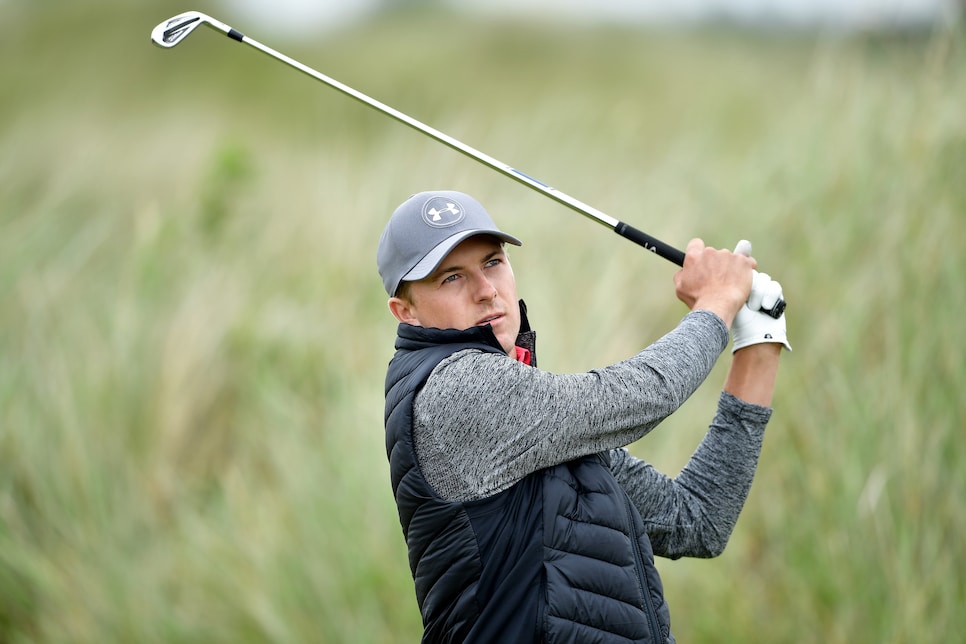
Jordan Spieth
Stuart Franklin
Go ahead and laugh—but Spieth’s Ryder Cup candidacy isn’t as far-fetched as it appears.
Spieth ranks ninth among Americans in Strokes Gained over the past six months and sits just behind Bradley in DataGolf’s Ryder Cup forecast. Much of this statistical foundation stems from stronger performances earlier in the year, however, as he’s managed just one top-20 finish in his last eight starts. If captain’s picks were based purely on current form, Spieth wouldn’t merit consideration. But Ryder Cup selections rarely operate in such a vacuum. Spieth brings institutional value; he was integral to the past five American Ryder Cup teams and remains deeply embedded in Team USA’s strategic brain trust. The political realities of professional golf also work in his favor—stakeholders at both the PGA of America and NBC Sports would welcome his presence in the competition. As we’ve witnessed throughout 2025, politics and golf remain inseparable when it comes to major decisions involving marquee players. This dynamic means that a single top-five finish during the playoffs could catapult Spieth back into serious Ryder Cup discussion, regardless of his recent struggles.The selection wouldn’t be based purely on merit, but it wouldn’t be entirely unjustified either.
How the U.S. Team shakes out (according to us)
Scheffler, Schauffele, Spaun, Henley, DeChambeau, English, Thomas, Griffin, Morikawa, Cantlay, Bradley, Burns
Follow Golf Digest Middle East on social media
Main Image: Sam Greenwood


