
 AR
AR

I suspect this will be one of the least popular posts about golf I ever write, because it’s so easy for the other side—the wrong side—to appeal to emotions, but there is a simple principle that applies here and is the bedrock of every argument I’m about to make:
A worker responsible for generating revenue has the absolute right to be paid a fair and commensurate price for his labor.
I include the word “absolute” on purpose, due to the fact that we’re talking about wealthy professional golfers, who live very different lives from, say, steel workers in Homestead, in 1892. It may feel laughable to call someone like Scottie Scheffler a “worker” and refer to the playing of Ryder Cup matches as “labor,” but that’s OK, because if you believe in the guiding principle, it applies to every human being and is not means-tested so that we can shame rich people into working for free while other people profit from their efforts.
Ted Bishop, former PGA of America president, said a decade ago that the PGA of America netted roughly $25 million for a domestic Ryder Cup before factoring in TV rights fees (which is currently under a 15-year, $440 million deal), and it seems likely that figure has risen in the meantime. Without the participation of the best players in the world, generating that kind of revenue would be impossible—imagine how the Ryder Cup would suffer if the 12 best Americans went on strike and refused to play. To argue that the players who are primarily and overwhelmingly responsible for that windfall shouldn’t get a share of it themselves is laughable. The truth is, they should be making more; securing their labour for $500,000 each is an absolute steal.
Maddie Meyer/PGA of America
On Tuesday, we published a less opinionated Q&A guide to payment at the Ryder Cup, and that’s a good resource for the specifics, but here are the pertinent facts:
—Since 1999, each U.S. Ryder Cup player has been given $200,000 for the charity of his choice.
—Starting this year, due to pressure from those players and their representatives, they are now given $300,000 for charity and $200,000 as a stipend, which is a fancy term for payment to the players themselves.
—The Europeans get nothing, and according to Luke Donald, that’s by choice. Earlier in the week, he said they met and opted to forgo any payment, that he was very proud of them for adhering to the “ideals” of the Ryder Cup, and that, “if you have those experiences that you remember for the rest of your life, that’s worth more than a couple hundred thousand dollars in the back of your pocket.”
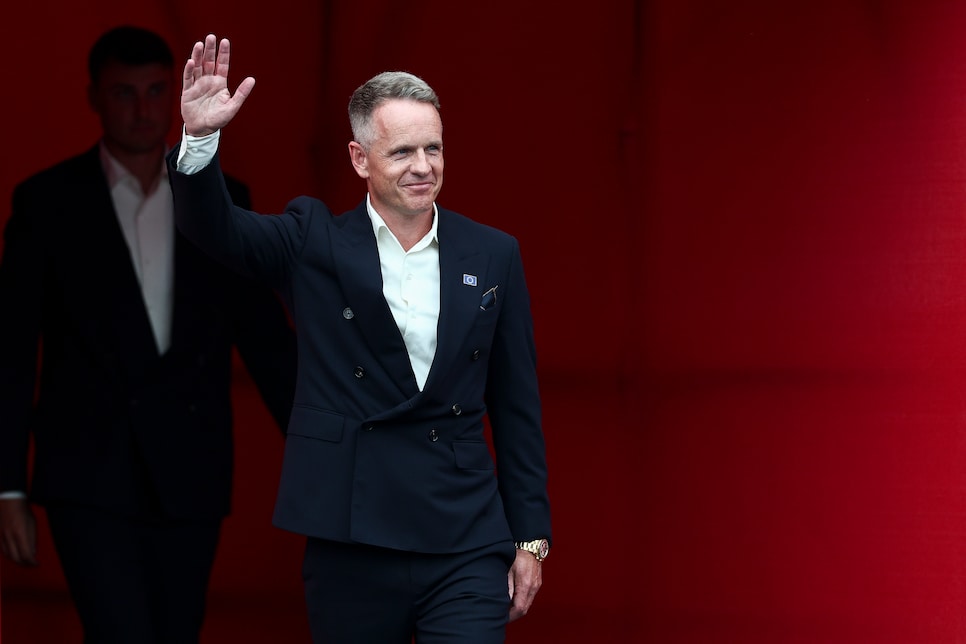
—In Wednesday’s opening ceremony, he took what seemed like a couple additional shots at the Americans, saying “it is not about prize money,” and, more pointedly, “we are fueled by something money cannot buy: Purpose, brotherhood and a responsibility to honour those who came before us, while inspiring those whose time is yet to come.”
View this post on Instagram
Donald’s position is interesting, considering that Europe recently lost a generation of potential captains when the European old guard seemed to go en masse to LIV Golf, and considering that two of his current players, Jon Rahm and Tyrrell Hatton, also went to LIV when it was entirely reasonable to suspect that it may cost them a spot at future Ryder Cups.
None of that smacks of brotherhood or honour or inspiration, but putting those ironies aside, his argument fails the essential test of the guiding principle above—that you deserve a fair and commensurate cut of any wealth you help generate.
Of course, Donald’s argument is a seductive one to make, and that’s where the whole thing gets complicated—on the side of public perception. It’s very easy to target American players as greedy, rich ingrates who are ignoring decades of tradition and corrupting one of the last remaining special sporting events by demanding to pad their already overflowing bank accounts. It’s why the effort to get a charity stipend was so difficult in 1999, according to Tiger Woods.
The media, frankly, eats it up; Brandel Chamblee was far from alone earlier this week when he said on Golf Channel that “asking to be paid for the privilege of representing your country is just antithetical to the honour of it. It would be like, you do a favor for a friend, and then afterwards, you ask to get paid for it. Tell me that doesn’t dishonour the gesture. And I think that will prove to be some corrupting element to the U.S. side.”
What Chamblee and others seem to ignore is that the Ryder Cup is not a charity endeavour, but a massive profit-generating event with $750 tickets and sprawling corporate hospitality tents and $300 sweaters in the merchandise tent. A more appropriate version of Chamblee’s analogy would be a friend asking you to go into business together, at which point you do most of the important revenue-generating work, your new company makes $30 million, and your friend pays you nothing. Oh, and then he gets mad at you for dishonouring the friendship by having the gall to ask for a fair share.
There is a similar weakness in the idea that the Ryder Cup is somehow sanctified by its history and thus sullied by this push for money. You only have to walk the grounds at Bethpage for five minutes to take in the thoroughly modern spectacle of the event and realise it bears no resemblance to the exhibition staged for the first 50 or 60 years of its existence. There are people in this world who know more about Ryder Cup history than me, but there are many—I wrote a whole book about it—and I appreciate how it survived through its various historical trials, and how it thrives today. I love its aura, and I say this because I want to emphasise that for me, players receiving money in this new era of multi-million-dollar profits does nothing to cheapen the Ryder Cup’s status, nor does it lead me to question their passion for winning. It’s a natural evolution for an event that has swelled to massive proportions, and it’s a long time coming.
Andrew Redington
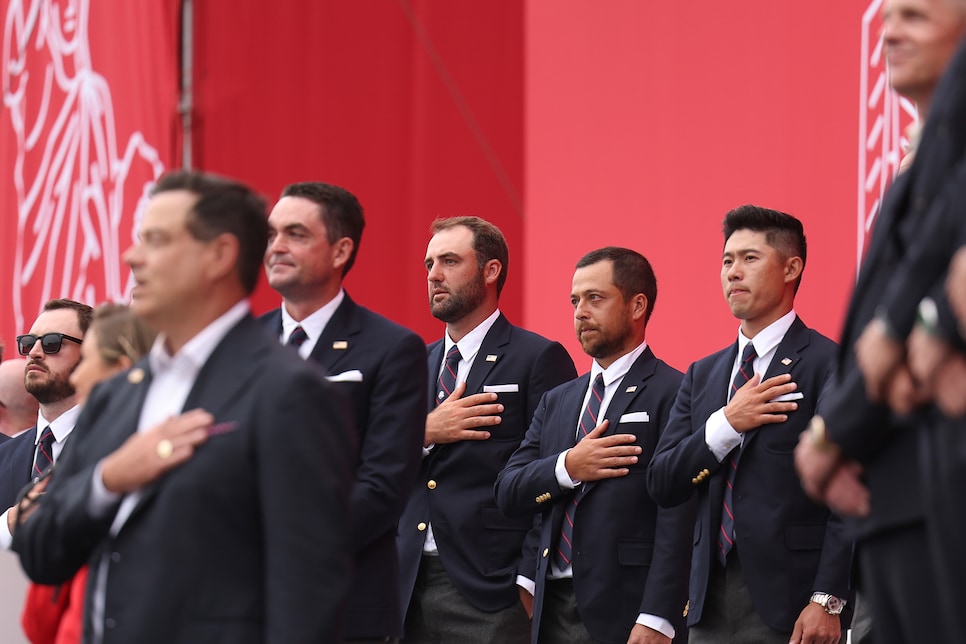
However, the U.S. players who were bold enough to antagonise for more money have also been cowed by the perception problems. In press conferences this week, they were badgered by reporters who wanted to know if they’d give their $200,000 stipend to charity, and players like Patrick Cantlay and Xander Schauffele, thought of as two of the main figures behind the push, confirmed that they would, as did Keegan Bradley, Scottie Scheffler, and others. You could tell they felt they had to give the money away, or they’d be in for a roasting.
It’s nice that they’ll donate their money to charity; it’s a good, moral choice. What’s not nice is the underlying implication that if they didn’t, the $200,000 would be ill-gotten. They deserve that money and more, even if they chose to spend it on something stupid and frivolous like—I don’t know—a private corn maze. The Europeans do too, and the concept that the DP World Tour needs the revenue of the Ryder Cup to survive is somewhat undercut by the fact that the PGA Tour covers its losses under the new strategic alliance.
You can disagree with the guiding principle that revenue generation deserves commensurate pay, but if you do, you should ask yourself where the argument leads. The top rank of professional golfers lead lives that most human beings can only dream about, but that doesn’t put them in an exempt class that should be coerced into working for free. They were right to demand their money, they should have the courage to stand by it, and smart people like Luke Donald should know better than to scold them for earning their rightful share.
Follow Golf Digest Middle East on social media
Main Image: Harry How


