
 AR
AR
Two years ago in Rome, and two years before that in Whistling Straits, we justified running our Ryder Cup report card on Saturday, rather than after the event concluded Sunday, by saying that “the match is tipping toward a conclusion before anyone hits a shot in Sunday singles.”
Well, we had to do it again; what a shame. But we’ve now updated this post to account for Sunday singles, which produced surprising drama after overwhelming European dominance through the pairs sessions. And now, we hand out grades for all 24 players.
We’ll start with Europe, going in alphabetical order, with a shout-out to Data Golf for the strokes gained statistics.
EUROPE
Ludvig Aberg (2-2-0): B
You’d never have guessed his grade would be this good on Saturday night, when he had a 1-2 record and some of the worst strokes-gained statistics for the road winners. Sure, he and Matt Fitzpatrick dominated over World No. 1 Scottie Scheffler and Russell Henley, but that was down to Fitzpatrick’s astonishing play, with Aberg hitting some big putts but working mostly in a supporting role. It got worse from there, with a blowout loss in Friday fourballs and another in Saturday morning foursomes, where Aberg was the worst player on the course by strokes gained. Then he did something massive—he defeated Patrick Cantlay for the only outright European win in Sunday singles and saved them from disaster with a critical point. The timeliness of that intervention alone merits a much better grade.
Matt Fitzpatrick (2-1-1): A-
Two wins, including an incredibly clutch shot in the final match on Saturday night to secure Europe’s last point (putting them definitively out of American comeback range), means Fitzpatrick had a stellar Ryder Cup. It could have been legendary had he held his 5-up lead against Bryson DeChambeau in singles, but the half point he contributed was massive nonetheless. He was a top-five player by strokes gained, and almost more importantly, his game was located somewhere on the moon in the first foursomes session, where he was, by far, the best player on the course. Competent play in his last two pairs matches yielded another point, and even though I’m dinging him slightly for losing Saturday morning, we should note that he was partnered with Aberg, who, as mentioned above, let him down. This was a big weekend for a guy who came in with a 1-7 record.
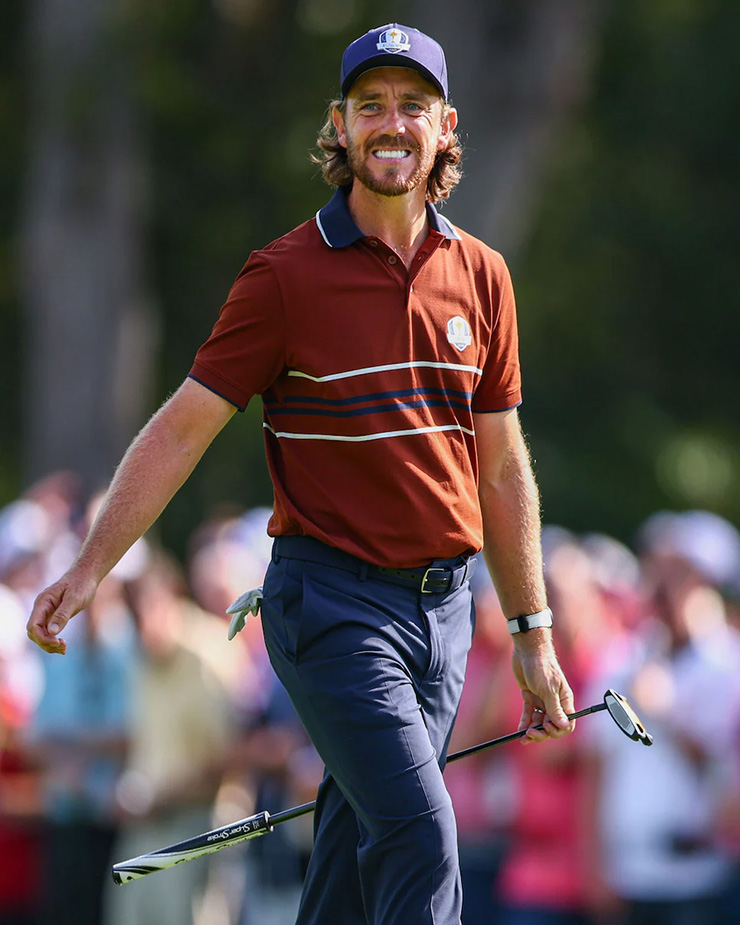
Tommy Fleetwood (4-1-0): A+
Vaughn Ridley
If this were only about the pairs sessions, you could add about 10 plus signs to his grade above, and there aren’t enough superlatives to crown him. Was he the best player by strokes gained, by far? Yes. Was he the only player who went 4-0 in pairs? Yes. Is he a golden Ryder Cup god who should have a statue of himself built in every town in England? Probably, yeah. But none of that gets at what it feels like to watch him, when he sticks almost every iron devastatingly close and buries long putts on the few occasions when he leaves himself more than five feet. Even the man’s body language with his teammates is beyond reproach; he looks like the best guy in the world to pair with, and along with stellar play, he brings so much positive energy to the team. He’s a superstar, and even the narrow loss to Justin Thomas on Sunday (and the missed chance to go 5-0), can’t undo his place as the best player at Bethpage.
Tyrrell Hatton (3-0-1): A-
Shane Lowry technically clinched the Ryder Cup, but Europe wasn’t resting easy until Hatton could get them to 14½ points and end any discussion that the Hovland envelope fiasco cost the Americans. Now, Hatton had the only perfect record at the Cup, so why does he get an A-? He was good, don’t get me wrong, but statistically, he was pretty much dead average among these 24 players. Like Fitzpatrick, his Saturday afternoon partner after filling in for an injured Viktor Hovland, he was at his best Friday morning, when he came out blazing as the super-team of him and Rahm got the first win. He dropped off a little Saturday morning, but had his big moments, and then on Saturda,y he fought valiantly through the tense final match to help Europe get to 11½ and put the Cup out of reach.
Rasmus Hojgaard (0-2-0): D-
Tough scenes for the Dane, and you can chalk a tough rookie campaign up to a little bad luck. His Ryder Cup debut came against a red-hot pairing of Justin Thomas and Cameron Young in Friday fourballs, and ended in a 6-and-5 drubbing. He didn’t play again in pairs, and probably for good reason—his strokes-gained numbers were poor, as were his partner Aberg’s, and it was a lamb-to-the-slaughter situation. When Saturday afternoon came around, the Europeans were so close to clinching an insurmountable margin that Donald clearly decided it wasn’t worth trying him out again. He had another shot in singles, and lose a tight one to Griffin, but he actually had the worst strokes gained of any player that day, so his grade must suffer accordingly.
RELATED: Europe’s Captain Everything reaches legend status, solidifies his place in history
Viktor Hovland (1-1-0): B-
Hovland struggled mightily in Friday morning foursomes, ending up as part of the only European pairing to lose in the session, and he wasn’t exactly scintillating in his other match Saturday. Still, he more than made up for all that with an incredible putt on 17 that kept the Europeans 1 up on Scheffler and Henley and led to a victory that gave the road team a five-point lead heading into the afternoon. We try to judge these grades holistically rather than by a single moment, but when the moment is that big, it merits elevating the overall mark. Meanwhile, Hovland was scratched from his final match Saturday afternoon due to injury and couldn’t play Sunday, so those two matches represent the sum of our judgment.
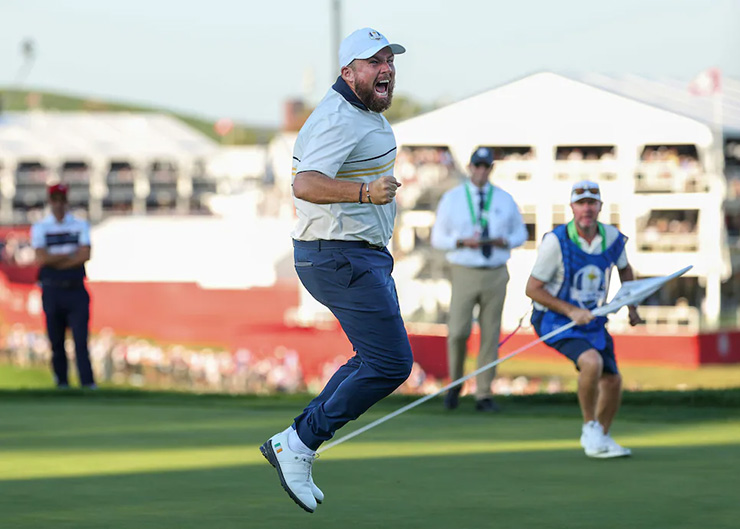
Shane Lowry (1-0-2): A-
Richard Heathcote
I swear Lowry lives the most charmed life in Ryder Cup history. The last two years, it’s been the same: He plays mostly mediocre golf, but he manages to win every match because his partner is electric, and at some point, he hits a big shot or a big putt to mask his otherwise iffy performance. Bethpage went just like Rome over the first two days, where he came away with 1½ points in two matches, and you have to give him credit for clutch play on 17 and 18 Saturday afternoon with Rory in an extremely hostile environment. Still, at that point, he was the fourth-worst player statistically of any player. But fair is fair, and on Sunday, he played an extraordinary singles match, where his strokes gained were second among all players, only to his opponent, Russell Henley. He hit a massive putt to clinch the Ryder Cup, and he deserved it.
Robert MacIntyre (1-1-1): B-
It was a touch underwhelming for Bobby Mac, finishing with negative strokes gained and not quite making the impact that I and a few others thought he might make. He never had a moment like his partner Hovland’s putt on 17 Saturday morning, but he was steady enough in foursomes overall, giving his team a chance to win both matches. It didn’t work out on Friday, but not for lack of trying—two dart approaches on 12 and 13 got his team to within one before the loss. He got his win on Saturday thanks in part to an approach on 14 that landed inside six feet, and led to the 1-up lead they’d hold for the rest of the match. He struggled on Sunday and was frankly lucky to get a half point against Sam Burns.
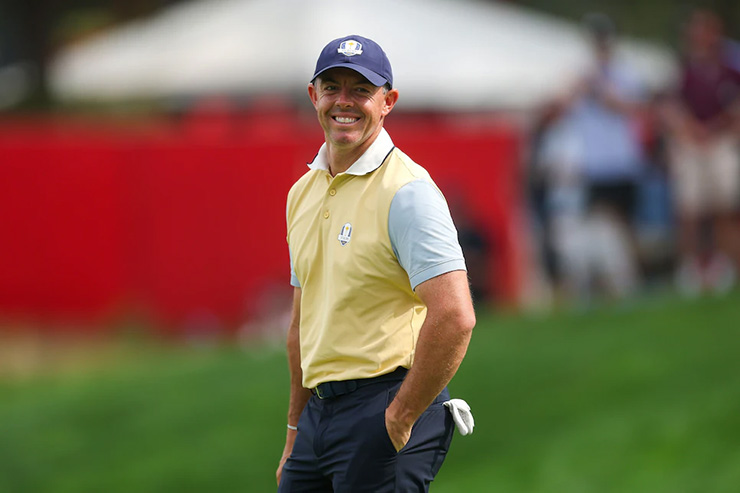
Rory McIlroy (3-1-1): A+
Carl Recine
It’s not just that he played well; it’s that he played well as the No. 1 target of the worst American fans, a small but vocal set who disgraced themselves with an endless stream of personal insults directed at McIlroy in all four sessions he played. The amount of strain he’s subjected to is almost unworldly, and he usually manages to thrive in spite of it. Even after the worst of those matches finished on Saturday afternoon, he didn’t take the chance to indict the fans. We should add here that Rory called his shot in Rome, predicting after that Cup that they’d win at Bethpage, and delivered with three wins and a tie over the first two days. By the numbers, he was only the fourth-best European at Bethpage, but his resilience and the massive putts he hit merit this A+. And no, I’m not going to hold a narrow Sunday loss to the best player in the world when he was near exhaustion against him.
Jon Rahm (3-2-0): A-
Rahm was an unflappable juggernaut through his first three matches, the alpha of alphas and the tone-setter for Europe, having gone out first in both Friday sessions. There has to be some penalty for losing his final two matches—like Rory, I think he was exhausted on Sunday—but even Saturday afternoon came down to the last hole, and Rahm’s aura is so enormous that when he had to chip in from the bunker to have a shot at a half point, I gave him a roughly 60 percent chance of pulling it off. The dreadful Sunday showing knocked his stats down a good amount, but before that, he was the third-best player by strokes gained, the second-best putter, and the best around the greens. The way he delivered as Donald’s flagbearer earns him an A- and enhanced his already stellar Ryder Cup legacy.
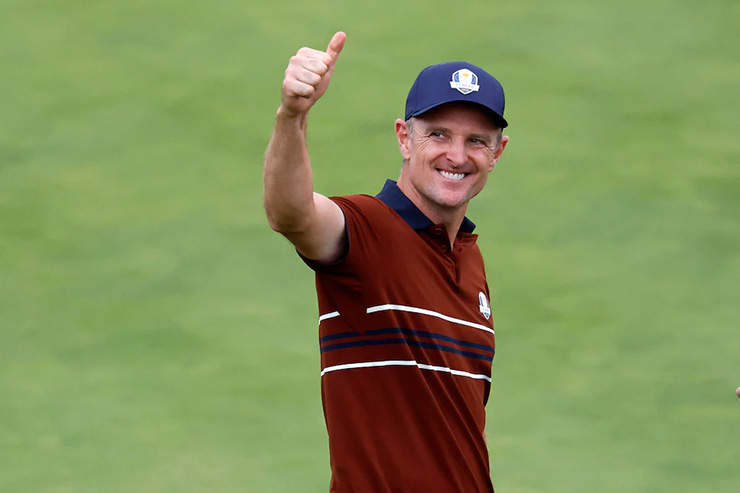
Justin Rose (2-1-0): A
Harry How
Just like in Rome, Donald called on the 45-year-old Rose to fill a very specific role: Play two fourball matches and do your best in singles. Granted, his assignment this time was a good degree easier, partnering with Tommy Fleetwood instead of a struggling Robert MacIntyre, but he was just as ready for the challenge. How did it go? Well, the man dropped every putt in sight, including the winning putt Saturday night to stretch Europe’s lead to five points—a margin that has never been surmounted on Sunday. Let’s put the putting into statistical context: On Saturday night, Jon Rahm was the second-best putter on any team by strokes gained, with +1.76 gained on the field for the whole event. Rose gained +4.88 strokes putting. Read that last sentence again, remember that he’s 45 years old, and let yourself melt in awe. Even on Sunday, playing the red-hot Cam Young, he fought hard to erase a three-hole deficit before finally succumbing on 18.
Sepp Straka (1-2-0): C-
For the most part, Straka did not deliver, despite winning a point on Friday afternoon, and he finished his pairs campaign by doing the seemingly impossible: losing a match with Jon Rahm on your team. That may sound harsh for a guy who went 1-2, but by strokes gained, he was the third-worst European. He did putt well, but his performance overall (this will sound harsh) lines up with him not making the cut at three majors this year. He did come away with a point, but he wasn’t especially solid.
RELATED: U.S. team broke itself with the Keegan Bradley debacle, but the fix is easier than it seems
UNITED STATES
Sam Burns (0-2-1): F
You don’t have to be a mathematician to understand that when you play two sessions and are the worst player by strokes gained in both of them, you will also be the worst player by strokes gained in the entire Ryder Cup. That was the situation on Saturday night, and even after tying his singles match against MacIntyre—another underachievement, since he actually played better—he only finished above Rasmus Hojgaard in strokes gained. Burns, sometimes thought of as the last captain’s pick, laid a complete egg for Bradley, and it was almost poetic that he was the last man on the stage Saturday night and Sunday night, missing a putt both times. Ironically, he did get a half point on Friday night, but that was almost entirely down to Cantlay, who played well enough both Friday and Saturday afternoon, but had very little support from his partner.
Patrick Cantlay (1-3-1): C
This was not the Patrick Cantlay we’ve seen in past team events. The stats and the record say Cantlay was mediocre, with 1½ points in four starts, but he was even worse than that in light of his team match-play history, where he’s become known for burying dagger putts in clutch situations. He showed a little bit of that old form late on Saturday, making his birdie on 17 to avoid going 1 down, but there just wasn’t enough of it. Throw in some woeful approach shots on 18 under pressure, and giving up the only full point in Sunday singles against an average Ludvig Aberg, and it was a disappointing Cup for Cantlay. Yes, he was hurt by partnering with Burns twice, but he didn’t do much to help his cause, and the Americans needed more from one of their veteran stalwarts.
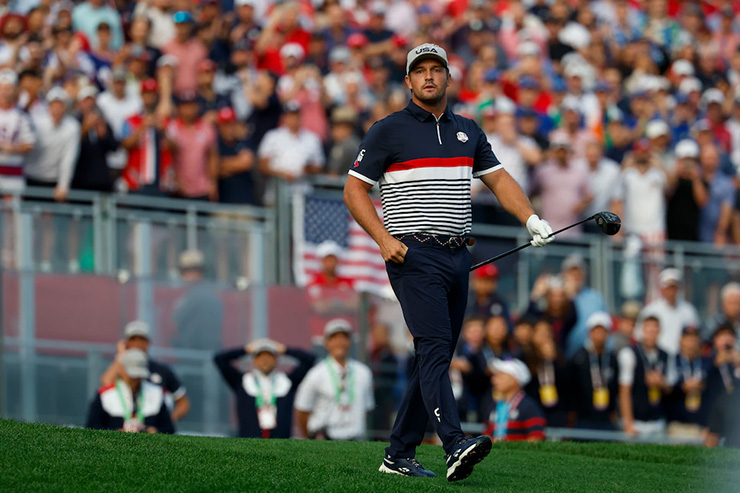
Bryson DeChambeau (1-3-1): B+
Harry How
How can someone who went 1-3 get a B+? Well, simply put, DeChambeau was really good for most of the Ryder Cup. On Friday, he was absolutely cursed by his partners, drawing the worst player on the course Friday morning in Justin Thomas, and the second-worst in the afternoon in Ben Griffin. He and Cam Young thrived in his lone win in Saturday foursomes, but then Young let him down in the afternoon in another loss. DeChambeau ended as the second-best American after Young, he brought the energy constantly, and the only real critique you can give is that he missed some key putts down the stretch Saturday afternoon. I can’t give him an A- just because he did go 1-3-1, but he can take pride in how he played.
Harris English (0-2-0): D-
I have a lot of trouble treating English too harshly here, for the simple fact that Bradley put him in literally the worst pairing possible from a statistical angle, twice, and both times he had to face Fleetwood and McIlroy. In other words, he was put in a position to lose, and that’s exactly what he did, badly. Then, as if his weekend hadn’t been hard enough, he had to sit out Sunday as the dreaded envelope man when Hovland got hurt. But facts are facts—even if Bradley let him down, he finished with the third-worst strokes gained of any American.
Ben Griffin (1-1-0): C-
Incredibly tough scenes for Griffin, the only American (and the only player overall besides Rasmus Hojgaard) who got just one start in the first four sessions. It wasn’t a good match, either, as you might expect; he played with Bryson DeChambeau, Bryson was great, but Griffin let him down enough that they lost 1 down to Fleetwood and Rose in a critical match. He started playing a little better late in the match, which is why his grade isn’t worse, but he finished with the second-worst strokes gained of the session and clearly inspired no faith from a captain who wouldn’t play him again. He did get a win in singles, but was still pretty bad, finishing as the second-worst player of the session. He was just lucky that his opponent, Hojgaard, was the worst.
Russell Henley (0-2-1): C+
Henley was supposed to be the answer to the question of, “Who do you pair with Scottie Scheffler?” after the Scheffler-Burns pairing crashed and burned over and over. They looked good together in Montreal, but here it was a dismal showing. Henley was rough from the first tee shot on Friday morning, and while he was better on Saturday morning—partly because Bradley started him off the correct tees this time—it still wasn’t enough to help the World No. 1 get over the finish line. Scheffler was average by his standards in both sessions, but Henley let him down. That said, he was phenomenal in singles, the best player on the course, and against anyone other than Lowry, he would have earned a full point for the U.S.
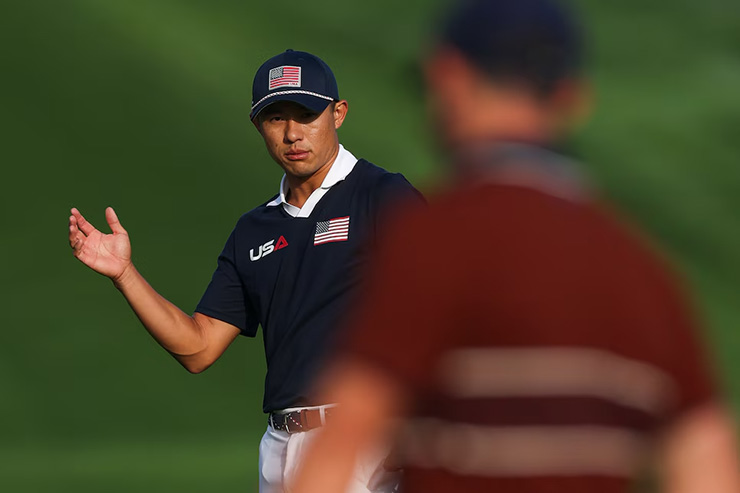
Collin Morikawa (0-2-1): D+
Carl Recine
See Harris English above—Morikawa was screwed over by an unbelievably poor captain’s decision and ran into a European juggernaut pairing twice on the way to two bad losses. He was slightly better than English from a statistical angle, hence the slightly better grade, but still struggled to get anything going beyond a few strong iron shots. Morikawa was a weapon in his first Ryder Cup at Whistling Straits, but it’s been nothing but struggle ever since, and it didn’t get much better in a very average halved match with Hatton in singles.
Xander Schauffele (3-1-0): B+
This was a stat-padder of a Ryder Cup for Schauffle, the leading American point-getter (tied with Young). After he got the opening win with Cantlay, it felt like the start of another strong Ryder Cup campaign, but though he ended 3-1, he didn’t really find truly excellent form until Sunday singles against a struggling Jon Rahm. Despite the record, he didn’t quite play like the Xander of old (particularly on Saturday morning when he was the second-worst player on the course), or to make a big putt, even as he grinded out his two pairs wins. He benefited from one great partner in J.J. Spaun, and then brought it in singles, but this was a little like his 2025 in general—fine, but not up to his sky-high standards.
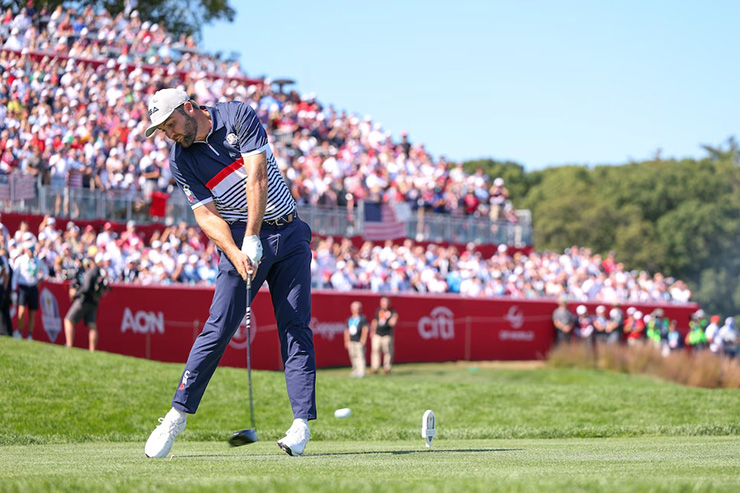
Scottie Scheffler (1-4-0): C-
Andrew Redington
I wrote a mildly critical piece on Scheffler on Friday, and I still think it’s incredible that the Americans have spent three decades unable to figure out how to get wins with a generational player (between him and Tiger). He wasn’t quite as terrible as his record would have you believe through the pairs sessions, but he ended in the bottom half of all Americans in strokes gained. So what gives? Well, small sample size and variance—sometimes his partners let him down, and when they didn’t, as in his Saturday afternoon with DeChambeau, they ran into juggernauts in Rose and Fleetwood, neither of whom seemed capable of missing a putt. He did get his win against Rory on Sunday, but Rory was correct in calling it a “pillow fight,” and it was actually Scheffler’s worst session of the event. Make no mistake—a guy this good going 1-4 was a killer for Bradley and the Americans.
J.J. Spaun (2-1-0): B+
I was excited this week to see Spaun play, after getting a sense of him as a strong pressure player both at the Players, where he fell just short of winning, and at the Oakmont U.S. Open, where he became a major champion on an impossible track. In his first match with Scheffler on Friday afternoon, he was so-so, but late on Saturday afternoon, he showed what he was made of with a dynamic finish to his match and a frankly pretty surprising win over Jon Rahm. On Sunday, he kept the good vibes going with a win over Straka that felt a little easier than the 2&1 margin would have you believe, and at this moment, it feels like Bradley screwed up by not using him more. The Spaun we saw late in the day Saturday and again on Sunday felt like a massive Ryder Cup asset, and his brilliant pressure play was one of the few bright spots for the U.S.
Justin Thomas (2-2-0): B-
What a puzzling Ryder Cup for Thomas. On Friday afternoon, he teamed with Cam Young to put together the best match the U.S. saw over two days, and a 6-and-5 victory. But earlier that morning, paired with Bryson DeChambeau, he was the worst player statistically on the course, and he wasn’t so hot Saturday afternoon in a painful late loss to McIlroy and Lowry when teamed with Young again. Then he came up big again on Sunday, with an iconic putt on 18 to beat Fleetwood and keep the faint U.S. hopes alive. Thomas has been one of the most reliable Ryder Cup and Presidents Cup players of his generation for the U.S., but here he only showed that brilliance in fits and starts. The high points were incredible, but the rest was a letdown.
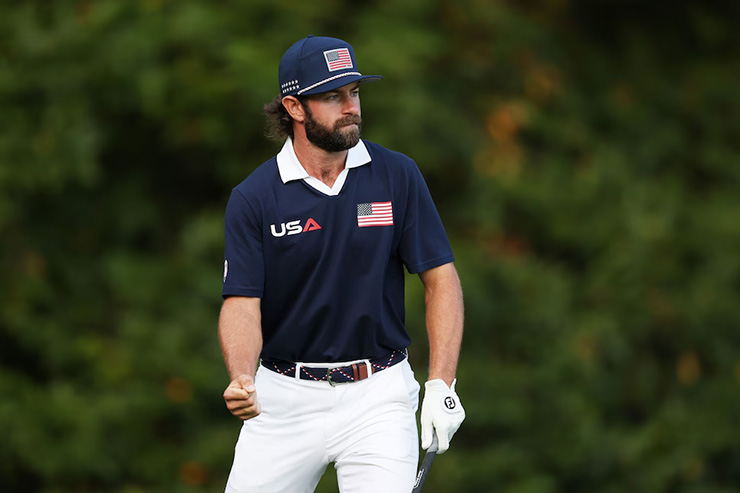
Cameron Young (3-1-0): A
Richard Heathcote
Man, did this guy deliver. Young finished as one of only two Americans with three points, and he ended as the top American statistically, too, gaining 5.06 strokes, second only to Tommy Fleetwood among all players. There was theoretically the most pressure on him, being the only native New Yorker on the team, but he rose to the occasion marvelously and more than rewarded Keegan Bradley’s faith in him as a captain’s pick. Even as the U.S. team went down in flames, he was the bright spot, and though a less-than-stellar Saturday afternoon session keeps him from an A+, overall, he gets great marks in his rookie Ryder Cup.
RELATED: The subtle way Europe has cracked the code to motivating its players
Main Image: David Cannon
Follow Golf Digest Middle East on social media


