
 AR
AR
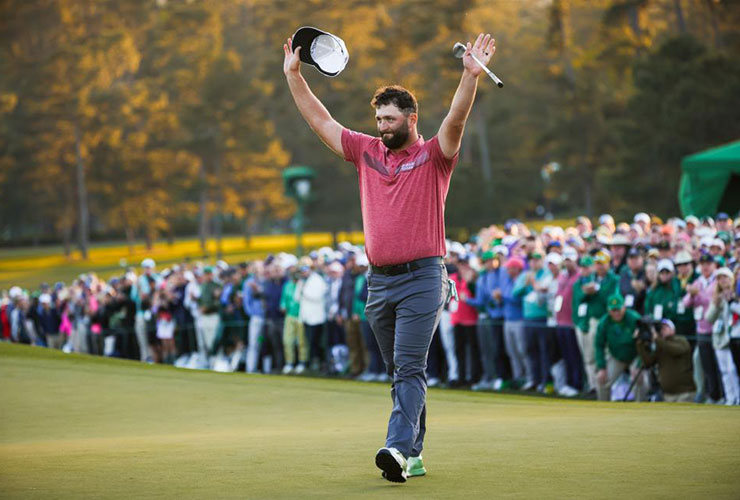
They roamed with purpose, Jon Rahm and Brooks Koepka, big and powerful and inevitable, like lions on the hunt. Hunt, that’s what we saw. The Masters is usually more romantic and less pugilistic. But romance went out the window after Friday’s 30-degree temperature drop and Saturday’s second coming of Noah’s Ark washed away the meek. And though there were others after the same prize, from the start of Sunday’s marathon, the field of 51 was really down to two, Rahm and Koepka, together in isolation, both knowing there was enough for just one to eat.
It wasn’t pretty, because hunts rarely are. It wasn’t dramatic, because hunts are only dramatic on Animal Planet. The thing about hunts is they are not won by the quickest or most ferocious. Those are assets, but the true arbiter of a hunt is a refusal to surrender. As his opponent lost his breath and succumbed to fatigue, Rahm stayed steady, remained patient and struck with precision. And for that he captured the 87th Masters Tournament.
“Hard to put it into words. Obviously we all dream of things like this as players, and you try to visualise what it’s going to be like and what it’s going to feel like,” Rahm said after authouring a final-round 69 for a four-shot win at 12-under over Koepka, who closed with a 75, and Phil Mickelson (65). “And when I hit that third shot on the green [at the 18th], and I could tell it was close by the crowd’s reaction, just the wave of emotion of so many things just overtook me. Never thought I was going to cry by winning a golf tournament, but I got very close on that 18th hole.”
Rahm established himself as a big-game hunter well before this week. He won the US Open in 2021 and owns nine top-10 finishes at majors. He was a one-man wrecking crew for Europe’s losing side at the pandemic-delayed 2021 Ryder Cup. He had 19 worldwide victories, six of them coming since last year’s trip to Augusta. The only thing that briefly extinguished his early season heater was a stomach bug at the Players Championship. He returned to No. 1 in the world on Sunday and certified his reputation as one of this generation’s certified alphas, a standing he cemented on Thursday when bouncing back from a four-putt double bogey at the first to turn in a 65.
He’s also that rare talent who is judged not against his peers but to the past, forever linked with his fellow countryman, the great Seve Ballesteros, and that comparison casts a mighty shadow. In some ways, it is a lazy analogy. OK, Rahm shares the spirit for competition that Seve did, and possesses the soft touch capable of conjuring magic around the greens. But Rahm’s game is more consistent and measured and total, a game that produces rounds that can come off as plodding in the best possible connotation. He knows what he needs to do, then sticks to the plan. Ballesteros? A tortured artist whose work sometimes went way outside the canvas.
April 9 and Spanish golf 🇪🇸 https://t.co/VlW3KHf3EX
— Justin Ray (@JustinRayGolf) April 9, 2023
Conversely, though that creativity came at the expense of results, there was no doubt the beauty of what Seve produced. Perhaps it’s no surprise that one of the few critiques of Rahm is that it would behoove him to deviate from script and recognise that golf calls for bravado and occasionally a bit of wild cowboy. He had reached the sport’s apex with that US Open victory, and whatever happens after doesn’t supercede the climb. However, there are a select few that are held to a different standard. That one mountain isn’t enough. Their talents beget more summits to reach, and failing to add to that total is seen as squandered potential. The standards are vicious, but that is the deal with stardom. Rahm is blessed with that curse, those top-10s seen by some not as a display of Rahm’s talent but an indictment that when the golf matters the most, Rahm’s golf routinely falls just short. That includes at the Masters, where Rahm finished T-9 or better four times but never contended late.
Sunday offered the chance for Rahm to rewrite his story and do so with vigor. Multiple weather delays meant 30 holes were on tap for the final day at Augusta National, and though the green jacket is never conferred, it would take a special type of fortitude to don it this time. Resuming his third round on the seventh green, Rahm’s four-shot deficit to Koepka was cut to two as they walked to the eighth, Rahm making birdie to Koepka’s bogey. Any aspirations of a Sunday morning charge, however, were quickly erased.
It was no longer raining in Augusta and the dulcet tones that bounced off the loblolly pines assured the sub-air systems were at work, but the grounds remained wet and the sky remained cold, so the course played long and tough. It was unwise to be aggressive and those who tried were punished.
“It was a tough day out there. It was windy, and all those wind gusts are not easy,” Rahm said. “You can hit good shots that are going to end up in bad spots, and it happened to everybody.”
That included Sam Bennett, the amateur paired with Koepka and Rahm who for two days held his own with the pros but suddenly looked like a boy among men and became nothing more than a bystander as the morning went on. Both Koepka and Rahm played steady, albeit unspectacular golf over their final 11 holes, putting the two in the final group for the afternoon, a heavyweight billing that major championships often hype but rarely deliver.


