
 AR
AR
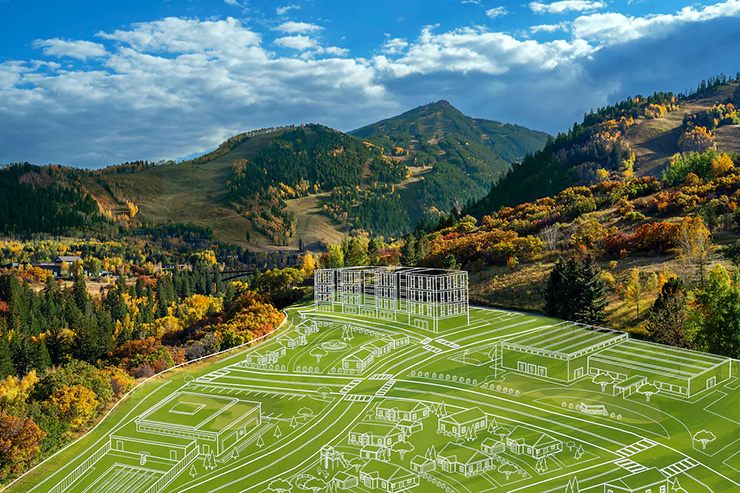
Golf’s most valuable piece of land is unintentionally unknown to most golfers. Turn onto 91st Street in Surfside, Fla., north of Miami Beach, and you’ll encounter a highly ornamented, police-gated bridge that looks like an entrance into a country club. In a way, it is. Indian Creek Village has become an enclave for society’s richest individuals. Mark Zuckerberg and his wife just closed on a $170 million, 1.8-acre mansion. Jeff Bezos is building his estate on multiple parcels of land, and around the corner lives Tom Brady, among other famous residents. There are only 41 homeowners inside the community known as Billionaire’s Bunker on the manmade barrier island in Biscayne Bay.
At the heart of this sanctum is Indian Creek Country Club, an historic William Flynn design from 1929 that was recently renovated by architect Andrew Green. The course was here before any of the big homes. The elite like to escape here not only because this 294-acre island is ultra-secure but because the golf course has intrinsic value. Preposterous as it may be to calculate what the land locked in 18 holes such as these is worth, we posed that very question. It’s an impious topic, of course. No golfer with a soul would ever propose bulldozing Indian Creek, Pebble Beach or any other great course for real estate development.
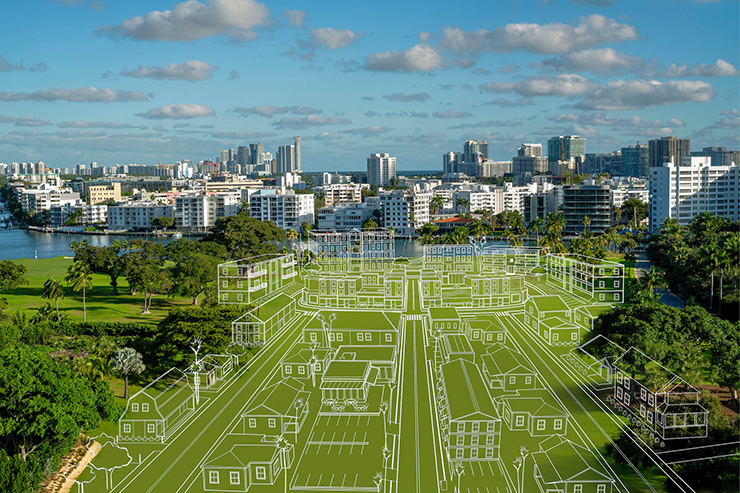
SAFE HAVEN: Wealthy neighbours are confident Indian Creek will stay the same.
Frazer Rice, a strategic asset manager, author and podcast host of “Wealth Actually,” started this exercise by evaluating the land and zoning restrictions for all courses in Golf Digest’s most recent ranking of America’s 100 Greatest Courses. He then ran comparison sales and identified government restrictions to arrive at a hypothetical value for each property if sold for the highest and most legally permissible use under current zoning. He also looked at standouts outside the top 100, such as Indian Creek and Maroon Creek Club in Aspen, Colo., to help offer a comprehensive geographical representation of our game’s greatest assets.
“The land [that LACC sits on] is so valuable and has such high commercial potential because of the surrounding developments. The land would be snatched so darn fast.”
–Dan Spiegel, managing director of global operations at Coldwell Banker
Per Rice’s modelling, Indian Creek blew away every other course with its estimated $3-5 billion price tag. “The island’s exclusivity and ultra-luxury residential context make this the highest per-acre estimate of any course in this analysis,” Rice says. Unlike all his other course valuations, Rice went purposefully more conservative for Indian Creek, “accounting for the reduction in exclusivity and scarcity driving down the value, plus the assumed need for more infrastructure such as additional roads, sewage, utilities and commercial development, stores and such, to handle the significant increase in population.”
Our phantastic scenario can also be read as a reminder that premier golf land is irreplaceable and continues to be the most coveted private land in the United States. “Not because of what it’s worth if you tear it down—but because nobody is ever going to assemble it again,” says Bert Guy, a Tuscaloosa-based attorney and president of Campfire Golf, which has developed some of golf’s hottest destination clubs such as The Fall Line in Georgia, Childress Hall in Texas and High Grove in Florida. “Indian Creek isn’t valuable because it could be 41 more mansions. It’s valuable because the 41 mansions next to it depend on it staying exactly what it is.”
The highest-value land that has the highest potential to be developed is likely Wynn Golf Club, sitting on 130 acres within the Strip of Las Vegas.
Some other unrealistic but fascinating case studies are on the West Coast. In Beverly Hills, overlooking Bel-Air Country Club is the most expensive home ever listed in the United States, a 70,000-square-foot mega mansion owned by Qatar’s royal family priced at $400 million. The golf course, recently remodelled by Tom Doak and hosting the 2026 Curtis Cup, would fetch about $1.8 billion, Rice says. As you play the fourth hole at Los Angeles Country Club’s North course, you can admire Lionel Richie’s $30-million home. Rice ran the numbers on LACC’s two 18-hole courses comprising 325 acres in the affluent Brentwood section of LA and estimated it’d be worth somewhere between $3-8 million per acre, so as much as $2.6 billion. Dan Spiegel, managing director of global operations at Coldwell Banker, adds, “That land is so valuable and has such high commercial potential because of the surrounding developments. The land would be snatched so darn fast.”
Of course, for all the supposed temptation to develop this prime real estate, clubs like LACC survive because the surrounding wealth needs the land to remain untouched.
“LACC does a better job of protecting Brentwood property values than any HOA in California could ever dream of,” Guy says. “The course isn’t a holdout against development. It’s the architecture that makes the surrounding development valuable.”
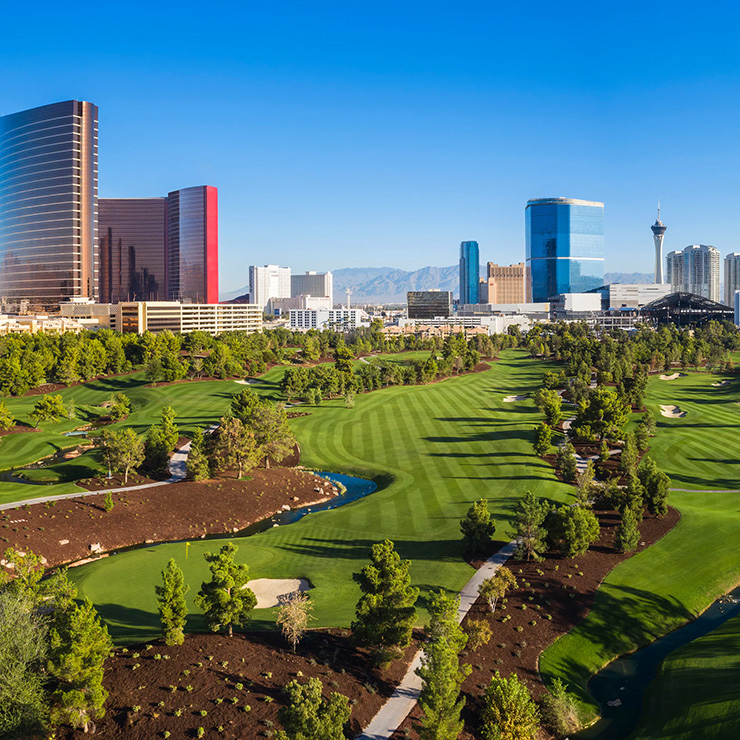
DECENT ODDS: Las Vegas is the rare place where golf might turn into buildings.
The highest-value land that has the highest potential to be developed is likely Wynn Golf Club, sitting on 130 acres within the Strip of Las Vegas. Originally conceived by casino magnate Steve Wynn on the site of the old Desert Inn course, the land of this Tom Fazio creation has already been rezoned for potential resort expansion, according to Clark County plans, and has been openly discussed by Wynn Resorts. “It’s among some of the most commercially valuable land in the United States,” Rice says. For comparison, MGM paid roughly $562 million for 37 acres behind Bellagio in 2021.
How about Pebble Beach, golf’s greatest meeting of land and sea? Picturing high-rises along the iconic seventh tee box is enough to make golfers sick to their stomach. Don’t worry; it’s highly unlikely Pebble Beach’s owners would ever sell the property. Also, California’s restrictions via the Coastal Act would severely limit any development. With those caveats, $880 million for this land is perhaps a conservative number. A 7,700-square-foot home along Pebble’s 11th hole sold for $24 million in March 2026. Heaven forbid condos ever do go up, the inland holes wouldn’t have the same value as the land directly along Stillwater Cove with ocean views.
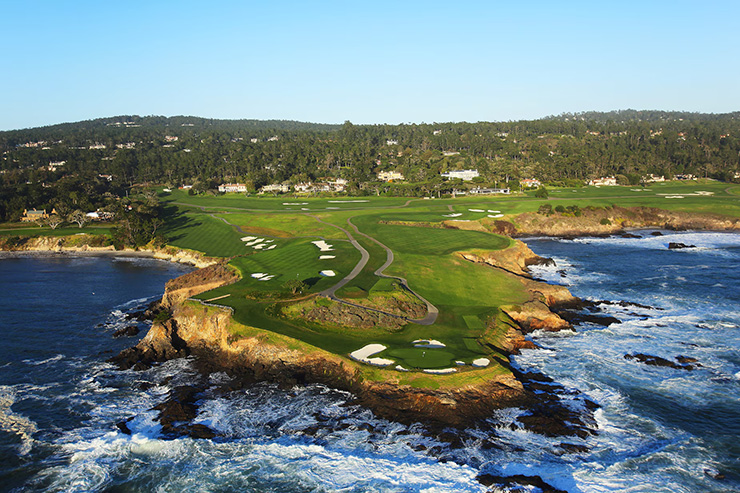
RARE BEAUTY: Golf developers will never again find available land like Pebble Beach. Stephen Szurlej
In the highly sought-after land of Long Island, where eight of America’s 100 Greatest Courses reside, Maidstone Club in East Hampton, N.Y., slightly edges Sebonack and Shinnecock Hills for the most valuable land, with estimates ranging up to $1.5 million per acre for high total value of $300 million. To buy the land to build Sebonack in 2001, Michael Pascucci paid $46 million in cash to the International Brotherhood of Electrical Workers’ Union Local 3 and then donated 54 acres of wetlands to the town of Southampton. His land today is worth $253 million, says Rice, or 554 per cent more than he paid for it 25 years ago. Of course, Pascucci, who has become one of golf’s marquee developers with his Apogee Golf Club in Hobe Sound, Fla., would never sell the land to be used for something other than golf.
The current boom in course construction has many developers searching for cheap land in remote areas. Developers like Guy are trying to replicate the model of Indian Creek or Maidstone, deliberately assembling the kind of acreage many of these older clubs acquired almost by accident. Whether they can succeed is perhaps the more important question than if Medinah can ever be subdivided. Golf clubs have become the de facto vehicle for a privacy economy that real estate alone can’t deliver. “The land is valuable because of the golf—not the other way around,” Guy says.
LAND HO!
The list below represents projected land value for ten notable golf courses, calculated by taking the hypothetical value of each property if sold for its highest and best legally permissible use under current zoning. We chose a geographically diverse selection of clubs to illustrate a wide selection of various markets and appropriate value based on recent transactions.
ISLAND
Indian Creek Country Club
Indian Creek Village, Fla.
Estimated acreage: 180
Value: $3-5 billion
MAJOR CITY
Los Angeles Country Club
Los Angeles
Estimated acreage: 325
Value: $2.6 billion
RESORT
Pebble Beach G. Links
Estimated acreage: 176
Value: $880 million
WEST COAST
The Olympic Club
San Francisco
Estimated acreage: 300
Value: $750 million
DESERT
Wynn Golf Club
Las Vegas
Estimated acreage: 130
Value: $520 million
FLORIDA COAST
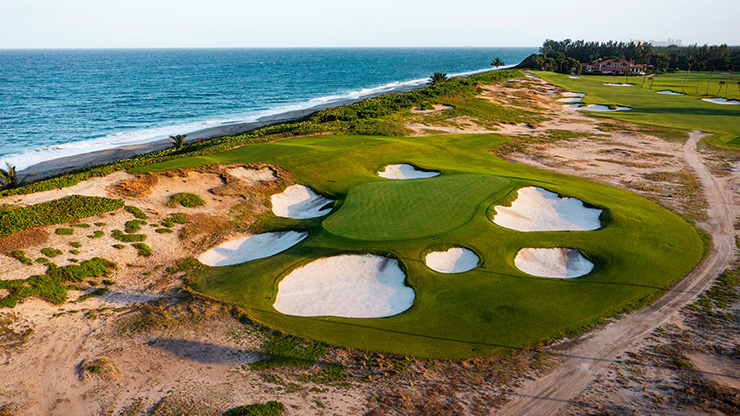
Carlos Amoedo
Seminole Golf Club
Juno Beach, Fla.
Estimated acreage: 175
Value: $437 million
LONG ISLAND
Maidstone Club
East Hampton, N.Y.
Estimated acreage: 200
Value: $300 million
MOUNTAIN
Maroon Creek Club
Aspen, Colo.
Estimated acreage: 200
Value: $300 million
SUBURBAN
Winged Foot Golf Club
Mamaroneck, N.Y.
Estimated acreage: 280
Value: $252 million
MIDWEST
Medinah (Ill.) Country Club
Estimated acreage: 650
Value: $130 million
Follow Golf Digest Middle East on social media
Main Image: Evan Schiller


