
 AR
AR
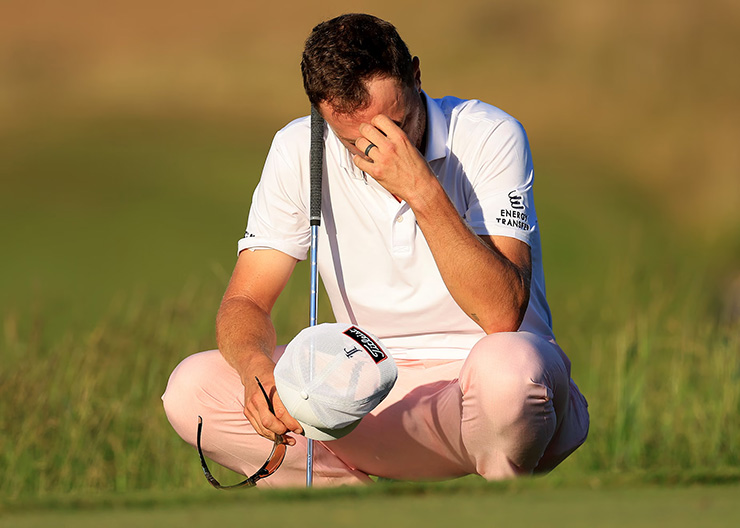
Xander Schauffele glanced skyward after a three-putt at the 12th, a brief petition to whatever authority might intervene, then dropped his eyes knowing no appeal was coming. He gathered himself and moved to the 13th tee, carrying what everyone else at Shinnecock Hills was carrying Saturday. “Just kind of a long day,” he would say afterward. “U.S. Open day.”
After two days of grumbling that the set-up lacked teeth, Shinnecock and the USGA found their nerve, leaning into everything this course is capable of, and perhaps announcing what Sunday intends.
On Friday evening players received a text from tournament officials that the greens would be firmed and quickened. Then the wind arrived and never left, bending the flags into shapes they weren’t designed to hold. The recipe wasn’t complicated. Missed approaches that might have been recoverable on Thursday or Friday were now problems without solutions. There were no easy pitches, no gimmes waiting on the other side. Saving par required earning it.
The raw numbers don’t fully convey that sentiment. A 73.6 scoring average, not quite a stroke-and-a-half higher than Friday’s 72.25, reads as demanding but not deranged, the kind of difficulty a national championship is supposed to produce. The texture tells a different story. Of the 72 players who teed it up in Round 3, just two finished under par: Scottie Scheffler and Emiliano Grillo, although rumours circulated in the field that Grillo actually shot his 67 at National Golf Links of America and nobody caught it. For posterity, only a missed putt at the last separated Wyndham Clark from red figures. He had sprayed it everywhere and it didn’t matter; the man was Michael Myers, absorbing every punishment the golf course threw at him and kept coming, a threat to everyone still breathing. He leads by six with 18 holes remaining.
But set Clark aside. The cruelty of Saturday is in the details. Rory McIlroy made three straight birdies on the front nine and looked like Clark’s biggest threat. The back nine ended that: five bogeys, no birdies, a slide from second place to outside the top 15. The same back-nine dissolution that swallowed him Friday, written out again in the same handwriting.
Matt Fitzpatrick arrived on Saturday as perhaps the most naturally suited man in the field: a U.S. Open champion, a precision ball-striker, a player built for exactly this kind of examination. He opened bogey-bogey-bogey and spent the rest of the day in irrelevance.
Schauffele came in with seven top-10s in nine U.S. Open starts, a record of endurance in this championship that belongs in a different conversation than almost anyone in the field. If the day demanded survival over brilliance, he was the logical candidate. He doubled the 10th. He doubled the 12th. He shot 73.
Collin Morikawa stumbled through the first three holes and never found his footing. Sam Stevens birdied the opener and went four over the rest of the way. Harry Higgs, one of the last groups out, is T-42. Justin Thomas was in the mix, only to make four bogeys and a triple.
Shinnecock didn’t discriminate. It just collected.
Christian Petersen
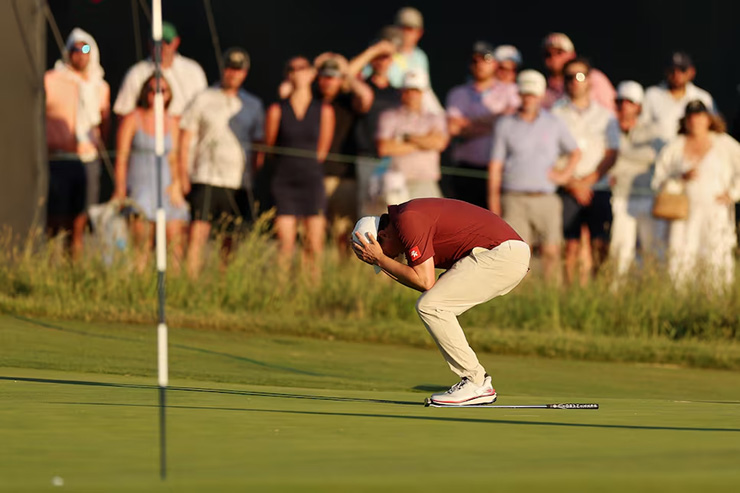
For a window Saturday, it looked like the USGA had done it again. Dylan Wu, out of the leadoff group, made an 8 at the first hole on a five-putt. Ten minutes later, the second pairing stood on the green and waited; Chris Gotterup couldn’t pull the trigger on a three-footer because the wind kept moving his ball. When he finally knocked it in the ghosts showed up uninvited: 2004, 2018, Zach Johnson squinting through sunglasses to inform the world that they’d lost the golf course.
Saturday, they didn’t. As the round wore on, good approach shots held their ground. Balls stayed where they were asked to stay. Putts didn’t bleed off the edges of greens. Shinnecock was unrelenting and at times diabolical, but it was fair, which is the only word in golf that matters more than the score. Saturday threaded that rarely-attained ideal the U.S. Open chases, where the best players alive are made to look mortal, where bogeys feel earned and birdies feel stolen, where “good bogey” is said in complete seriousness.
The USGA took a wound in 2018 that never fully closed, the suggestion that protecting par had become more important than protecting the integrity of the competition. No such debate existed Saturday. Player after player said the same thing; Shinnecock was every bit as brutal as it appeared, and every bit of that brutality was deserved.
“It was kind of a bit of a guessing game in terms of what kind of bounce you’re going to get, soft or firm,” Scheffler said. “Especially coming into the greens, the fairways are starting to really firm up, so they were playing narrow. As this golf course gets firmer and firmer and with the wind up, it just—only a couple rounds under par. It’s extremely challenging out there.”
“The places where you can hit it are very small, so you still have to hit a good shot to the right place and then go from there,” Tommy Fleetwood said after a 70. “It’s not as if you can hit bad shots and get away with it. I think it’s been fair. It’s the U.S. Open and we’re into the weekend—I think we can expect it to be quite difficult.”
Perhaps Sahith Theegala said it best: “It was awesome today. I think this was probably how the viewers and all golf fans want to see the course play.”
There is one round left, and it’s unlikely that it will get much easier. Given Clark’s lead and his gift for rubbing some the wrong way, perhaps the club quietly replaces the greens with hardwood floors before sunrise. But short of that, something was settled this Saturday that the USGA has spent years trying to do. The U.S. Open at Shinnecock Hills was what a U.S. Open is supposed to be.
MORE GOLF DIGEST U.S. OPEN COVERAGE
U.S. Open 2026 Power Rankings: The entire field ranked at Shinnecock Hills
U.S. Open 2026 prize money: Here’s the record payout each golfer will earn at Shinnecock Hills
The Shinnecock greens are so tough Alex Fitzpatrick is practicing with … a VR headset?
Why players were strategically skipping practice rounds on Monday
Tommy Fleetwood has made Open history that irks the hell out of him … and makes him proud
The USGA delayed its rollback plan to save golf from something much worse
Follow Golf Digest Middle East on social media
Main Image: David Cannon


