
 AR
AR
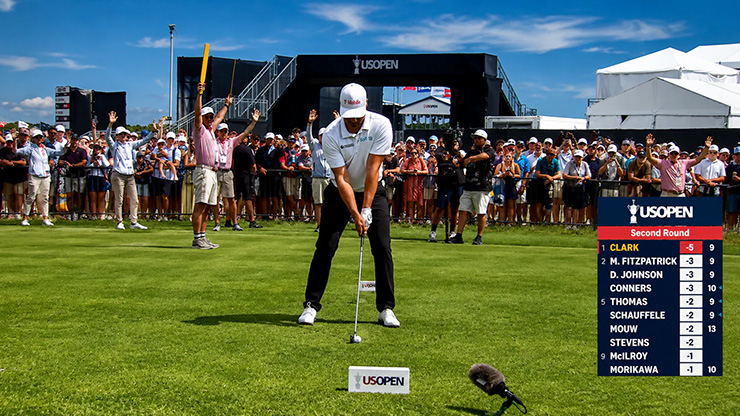
I stood aghast when I saw what was happening. Wyndham Clark, the 36-hole leader of the 2026 U.S. Open, dropped his ball onto the ground on the tee box on the first hole, then hit his shot—without teeing up his ball.
Clark did it again on the 10th and 15th holes; both par-4s where he used an iron off the tee, but he has gone tee-less on multiple par-3s each of his rounds at Shinnecock, too.
It’s a rare sight. Almost every PGA Tour player uses tees whenever they can, including on par-3s and on par-4s where they’re teeing off with irons.
RELATED: The golf world doesn’t know what to do with Wyndham Clark
“It’s something I’ve kinda figured out during the years,” Clark said. “I used to use a tee on certain holes, but I don’t anymore.”
These are those certain holes—and his logic for each.
When Wyndham goes ‘no tee’ on Par-3s
Par-3s are a judgment call for Wyndham. If the hole is downwind or down-across, he’ll use a tee. But if the hole is playing into the wind, or cross-into, then he’ll go without a tee.
“I just found that when the hole was into the wind, teeing it up would lead the ball to getting up there a little too high,” Clark said. “Just putting it off the ground helps me get a little bit of that lower launch.”
And no, in case you’re wondering, no grass tees. Just a nice lie flat on the ground.
When Wyndham goes ‘no tee’ on Par-4s
Obviously, anytime Clark has a driver in his hands, he’s teeing it up. Higher if he wants more distance, lower if he wants more accuracy. A strategy so simple you should use it, too.
But anytime he’s got an iron in his hands? No tee. It’s for the same reason as his into-the-wind par-3s. On the shots he did this today, his shots averaged between 6 and 8 degrees of launch, and apexed less than 75 ft.
“I’m really just trying to keep the ball out of the air…If I can hit it in the fairway, I feel like I’m pretty deadly.”
Should you?
Probably not a great idea.
Wyndham Clark is a high-speed, high-ball hitter. His goal is keeping the ball down—that’s what gives him control.
For the rest of us, the opposite problem is true. And because we’re not operating with the same level of precision, the ball on a lower tee gives us some margin for error that we desperately need:
Taking data from all players with all irons, the gain is 12 yards—143.4 yards from the grass versus 155.3 yards off the tee. That’s a full club less to reach the green. It’s also nearly universal with each club as no iron from 3-iron to 9-iron showed less than a 9.7-yard increase. Does more distance mean more greens hit? You bet. On all shots from fairway-type grass, the green-in-regulation percentage for all handicaps was 36.2 per cent. With a tee, it was 40.7 per cent.
MORE GOLF DIGEST U.S. OPEN COVERAGE
U.S. Open 2026 Power Rankings: The entire field ranked at Shinnecock Hills
U.S. Open 2026 prize money: Here’s the record payout each golfer will earn at Shinnecock Hills
The Shinnecock greens are so tough Alex Fitzpatrick is practicing with … a VR headset?
Why players were strategically skipping practice rounds on Monday
Tommy Fleetwood has made Open history that irks the hell out of him … and makes him proud
The USGA delayed its rollback plan to save golf from something much worse
Follow Golf Digest Middle East on social media
Main Image: Supplied


