
 AR
AR
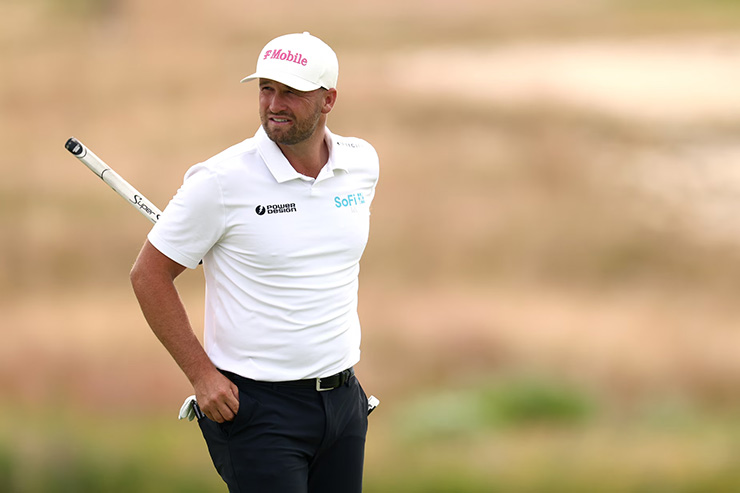
What do you make of Wyndham Clark? Not his performance through 36 holes at Shinnecock Hills, for that has been beyond criticism. A 64 on Thursday, a 69 to follow, a four-shot lead now waiting for the afternoon wave to take its turn with the course. That part of the equation resolves cleanly. The rest does not.
Because aside from those carrying the Saudi sportswashing stain, perhaps no player in good standing conjures as much bad feeling among the golf populace as the man now holding the national championship by the throat.
Start with the self-inflicted wounds, because there are several. Clark is temperamental in the way that stops being charming once the cameras find you. Not the brooding, calculating edge of a competitor processing failure; the kind of raw, unfiltered reaction that has a penchant of becoming the story. Last year alone, he generated two separate incidents during majors. At the PGA Championship he snapped his driver on a club throw reckless enough to draw a formal reprimand. Weeks later, at the U.S. Open, he damaged a locker in a moment of frustration that led to a suspension from Oakmont, turning a bad moment into a lasting footnote.
He has also developed an unusual gift for finding himself at the centre of rules controversies. Not as a perpetrator, exactly, but as a recurring presence. Back-to-back incidents at the Arnold Palmer Invitational put his name in the kind of headlines a player doesn’t solicit. The first involved the optics of patting down grass behind his ball, the second when he received a free drop in the fairway from a pitch mark. Clark was cleared both times, exonerated by the letter of the law. But golf’s relationship with rules is less legal than liturgical. Fans don’t require a verdict to form an opinion. They require proximity, and Clark keeps showing up in the wrong room.
He puts his foot in his mouth with the consistency of someone who doesn’t fully understand what he’s saying. He made a birth control crack at the Masters Par-3 Tournament that landed somewhere between edgy and baffling depending on your disposition. He ripped the course conditions at … checks notes … the hit-and-giggle Hero World Challenge. He sounded off on Brooks Koepka returning to the PGA Tour (“It’s kind of frustrating that he’s able to get the cake and also eat it”), a pointed sentiment given Clark himself had been entertaining a LIV offer years ago. He angered viewers last month with a lengthy mudball ruling at the CJ Cup, requesting free relief with the ceremony of a man filing a tax appeal. And then, upon winning that same tournament, announced plans to “open some grape,” a phrase that went viral mostly because nobody had encountered it before. (Clark later clarified on a podcast: “Sometimes I’m like, is this PC to say that we were just going to get absolutely sloshed?” Which is, in fairness, a reasonable question.)
He doesn’t mind stirring the pot. He showed up to the RBC Canadian Open’s rink hole wearing a USA hockey jersey, the golf equivalent of “tell your mom I said hi” while lighting a cigarette in your face. Cred where it’s due; it was funny. He also mocked Si Woo Kim at the 2024 Presidents Cup, mimicking the “Night Night” celebration Si Woo had done minutes before. That one landed differently.
WYNDHAM CLARK! ONE MORE!
Birdie at the last to take a 4-shot lead into the clubhouse. pic.twitter.com/2TF75HVvm7
— U.S. Open (@usopengolf) June 19, 2026
Then there’s the portion of the antipathy that resists explanation and lives below logic in whatever murky place sports feelings comes from. Charisma is not a learnable skill. Some athletes arrive in the world pre-wired for connection, exuding a frequency that fans receive without knowing why. Others labour in obscurity regardless of achievement, their excellence acknowledged and their presence forgotten. And some, the guys that make sports strange and genuinely human, inspire hostility that has no clean origin, no traceable wound, no incident you could point to in a courtroom and say, Here, this is where it started. It exists, ambient and durable, because some people just rub us the wrong way.
Sports fandom has never pretended to be rational, and the moment you apply the standards of reason to it, you’ve already misunderstood what it is. It’s tribal, visceral, occasionally embarrassing in retrospect. We do not choose what we feel in the stands or in front of the television. We discover it, often to our own surprise.
Clark lives somewhere in that unmapped territory. Not all of the feeling directed at him is earned, and some of it probably never will be.
One of the quieter casualties of professional golf’s civil war has been the slow extinction of the week-to-week villain. There weren’t many black hats to begin with, and the ones that existed have almost all defected to that other circuit, where they’ve calcified into irrelevance. The tour initially congratulated itself on its moral high ground, only to look up and realise that the players who made the neutral fan feel something, even irritation, had taken their act elsewhere. What remained was a largely agreeable roster of professionals who are easy to admire and almost impossible to hate. Golf has been whittled down to a sport of protagonists. The antagonist role sits empty, and the drama has suffered for it.
Which makes Clark’s moment at Shinnecock richer than a leaderboard story. Sports hate, properly calibrated, is not a problem to be solved. It is a resource. The worthy adversary sharpens the rooting interest, provides friction, makes the whole enterprise feel like it matters beyond the score. It takes genuine gusto to hold that role without collapsing into self-parody, and Clark, for all his complications, has managed it.
It is also worth remembering what he has carried that had nothing to do with temperament or tabloid moments. The death of his mother, and the mental health struggles he has discussed with a frankness this sport does not always reward or invite. These things do not excuse the other things. But they do what real context always does—complicate the read. Athletes who generate strong feelings are almost never simple, and the ones worth watching rarely are.
So … what do you make of Wyndham Clark? By late Sunday at Shinnecock Hills, the game may not give us the luxury of abstaining from an answer. Sports rarely constructs a neater piece of theatre than the antihero in the winner’s circle. And right now, four shots clear and apparently unbothered, Clark is making a very strong case for giving it to us.
MORE GOLF DIGEST U.S. OPEN COVERAGE
U.S. Open 2026 Power Rankings: The entire field ranked at Shinnecock Hills
U.S. Open 2026 prize money: Here’s the record payout each golfer will earn at Shinnecock Hills
The Shinnecock greens are so tough Alex Fitzpatrick is practicing with … a VR headset?
Why players were strategically skipping practice rounds on Monday
Tommy Fleetwood has made Open history that irks the hell out of him … and makes him proud
The USGA delayed its rollback plan to save golf from something much worse
Follow Golf Digest Middle East on social media
Main Image: Mike Mulholland


