
 AR
AR
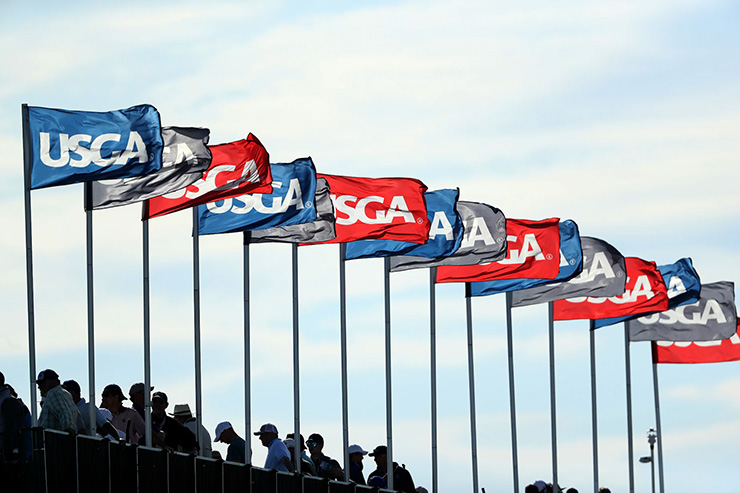
The words rolled off his lips cautiously and methodically, as if fearful that saying them out loud might land him in an HR office back at Golf House. Indeed, the idea of slowing down the greens at a U.S. Open would have been a fireable offence for previous USGA administrators overseeing the course set-up at the governing body’s marquee championship.
But as John Bodenhamer, USGA chief championship officer, addressed the media Wednesday on the eve of the 126th U.S. Open, he acknowledged the quiet part out loud: That another mistake in course set-up at venerable (and vulnerable) Shinnecock Hills Golf Club would be disastrous for the USGA. So much so that the association was making a dramatic audible in its plans for setting up the course just days before the start of the tournament.
If this week’s U.S. Open avoids the pratfalls that befell the 2004 and 2018 editions at Shinnecock Hills—when baked-out greens created unplayable hole locations that impacted the integrity of the championship—it will be because of a decision Bodenhamer and the rest of the championship committee made last Friday when faced with a weather forecast they hoped would never come.
RELATED: U.S. Open 2026 Power Rankings: The entire field ranked at Shinnecock Hills
It’s not rain that is the worry, but wind. Sustained prevailing southwest breezes of 12 to 24 mph are predicted for Thursday beginning at around 10:30 a.m. and lasting throughout the afternoon with gusts more than 40 mph. Friday looks to be slightly calmer, but Saturday brings a return of high winds in the afternoon, this time from the west/northwest, with gusts of more than 30 mph.
This wasn’t what was forecast as recently as a week ago when Bodenhamer arrived from Riviera Country Club after a successful U.S. Women’s Open. But the USGA meteorology team approached him Thursday night saying there were new models in play.
“That’s what changed everything,” said Bodenhamer, causing him to move forward with a “more conservative” set-up plan. Among the precautions the USGA is making as it moves forward:
- Syringing the greens before play during all four rounds as well as between the morning and afternoon waves on Thursday and Friday.
- Dialling back green speeds from 11½ and 12 on the Stimpmeter to the mid-10s.
- Taking extra caution on some of Shinnecock’s most treacherous green complexes, including on the par-3 seventh and par-3 11th holes.
If this feels like the USGA is going too far in the cautious direction, Bodenhamer explained the reasoning: “My experience … I’ve been doing this for almost 40 years with the USGA the last 16, and I have never seen a place like Shinnecock Hills when you get those drying conditions,” Bodenhamer said. “This place just dries down like nowhere else I’ve ever experienced, and we need to watch it and be very careful.”

Bodenhamer, speaking to the media on Wednesday, said the USGA’s changes to the course set-up were being done to keep the championship tough but fair. Mike Mulholland
The last time that Bodenhamer could recall U.S. Open greens running in the mid-10s was at the 1995 Open here at Shinnecock.
What does syringing entail? Here’s how Bodenhamer described it:
“Think about it as when you go into the grocery store and you go into the produce department and reach for that head of lettuce and that little mist comes on above and hits your hand. That’s all we’re doing to the putting greens. It doesn’t impact playability. It hydrates the leaf blade. When it evaporates, it keeps it cool enough so we don’t lose the friction on the putting greens.”
(This is when USGA CEO Mike Whan interjected: “If you had head of lettuce on your bingo card from JB, you can cross that off.”)
In order to make this possible, the USGA has moved up morning tee times for the first two rounds by roughly a half hour—starting at 6:35 a.m.—to provide more time between the waves so that the maintenance staff can apply the water.
RELATED: In the most Scottie way, Scottie doesn’t care (much) about the career slam
Even with conservative measures now in place, Bodenhamer remained on guard that trouble could still be lurking. His biggest fear is that the winds would get the greens dried out so fast that the greens speed up to a point where play has to be called.
“We have pulled every lever that we can to make it fair, and I think that’s a message we really want to get out there.”
Indeed, while implementing the new plan, the goals is to provide as level a playing field as possible for all participants.
“We’ve communicated this to the players,” Bodenhamer said. “We believe that it will present a more consistent playing presentation to both the morning and afternoon waves both days. It will be consistent across both days, which we think enhances competitive fairness.
“This is also a practice that is used on a regular basis right here at Shinnecock Hills Golf Club. In fact, if you ask the club, they’ll tell you they do it daily. It is just the nature of this club and the nature of this property to preserve turf health and so on.”
Will it be enough to avoid any disasters? Only Mother Nature can answer that question. But Bodenhamer knows that he and the USGA are doing everything in their power to allow Shinnecock to play tough but fair.
“For a USGA guy my whole life, my dream was always to play in and win the U.S. Open,” he said. “To sit back here and talk about hydrating greens, slowing green speeds, and modifying hole locations, that’s hard to do. But I’ll tell you what, I have great respect for this cathedral of the game and about these great players.”
Follow Golf Digest Middle East on social media
Main Image: David Cannon


