
 AR
AR
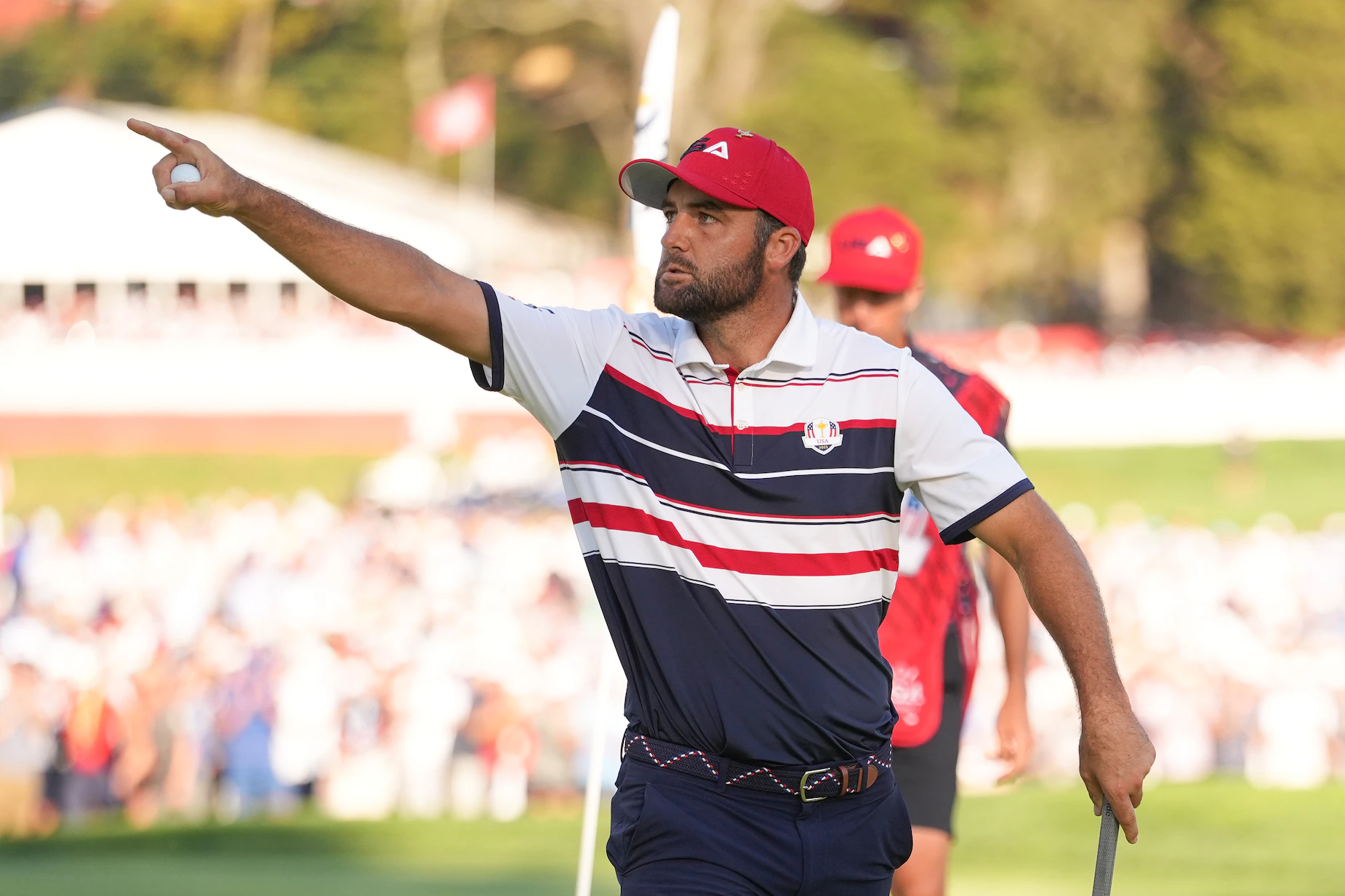
Twice in modern Ryder Cup history, teams have come back from a 10-6 deficit to win on Sunday, and those wild hours live on in our memories decades later—the Battle of Brookline, the Miracle at Medinah. The improbability of those days led to the general wisdom that any deficit wider than 10-6 is impossible to overcome, and the European lead on Saturday night at Bethpage of 11½-4½ seemed far beyond impregnable. Technically, that wisdom held up to the madness of Sunday. Technically.
And yet, this was no funeral procession. Midway through the afternoon, with several European flags on the board, it might have briefly felt that way, but the morass of inevitability then gave away to a furious surge that ended with the Americans tying the mark for the biggest win in a modern singles session, and nearly resulted in one of the greatest comebacks in sports history.
The first stirrings of real hope came in the first match of the day, when New York native Cam Young built a big lead against Justin Rose, lost it, and then buried a clutch putt on 18 to get the full point after all. 12-6, Europe.
CAMERON. YOUNG. #GoUSA pic.twitter.com/nOwwjdNMiN
— Ryder Cup USA (@RyderCupUSA) September 28, 2025
It wasn’t obvious that this would spark a deluge, but in the next match on 18, Justin Thomas took down the previously unbeaten Tommy Fleetwood with a clutch putt of his own, sending the crowd into raptures. 12-7.
JT FOR COUNTRY #GoUSA pic.twitter.com/YHIV8mByZv
— Ryder Cup USA (@RyderCupUSA) September 28, 2025
“I don’t know about any of you guys, but I haven’t felt anything like that playing golf before,” Cam Young said of the rally that was now fully on. “I mean, that was truly unbelievable to watch one after the other just start making putts, fighting the way that they did. I’ve never seen anything like that, and I’ve never felt anything like that watching golf, playing golf, doesn’t matter.”
In a match that was surprising both for its result and its margin, Xander Schauffele then beat Jon Rahm, dealing him his first Ryder Cup singles loss in three tries. 12-8. Moments later, on 17, Ludvig Aberg secured the only victory Europe would notch in the entire session, beating Patirck Cantlay and doing to him just what Schauffele had done to Rahm, dealing him his first singles loss in three Cups. 13-8.
“Captain had a message for us to worry about our own point,” Schauffele said. “Obviously it was hard not to peek when there was some USA chants ripping through the property.”
RELATED: European fans have flooded Bethpage
After Bryson DeChambeau secured a half point (13½-12½), Scottie Scheffler finished off his win over Rory McIlroy in the first ever Ryder Cup singles match between the No. 1 and No. 2 players in the world—a match McIlroy would later call a pillow fight. 13½-9½.
“One of the coolest things was these guys picking me up last night,” Scheffler said, of his 0-4 record in pairs play. “The guys on this team, this is a really special group of guys. We have a special captain, and I was proud to be standing there fighting with these guys today.
Still miles from achieving the dream, the U.S. had still closed the gap to four, and now it felt like roars were echoing around the course at increasingly fast intervals. It was J.J. Spaun who struck the next blow, safely two-putting from the fringe on 17 to close out Sepp Straka. 13½-10½.
Hat off, shake hands, add a point. #GoUSA pic.twitter.com/rsj1WEoDNE
— Ryder Cup USA (@RyderCupUSA) September 28, 2025
Down the scoreboard, every match left—just four of them now—was either tied or showed a U.S. lead. For the first time all weekend, the energy around the course felt palpable, and Russell Henley, 0-2 thus far in his Ryder Cup, seemed poised to deliver the next full point for the U.S. He had a birdie putt on 17 to clinch the win, but his trickler from above the hole stopped just inches short of the cup, and his opponent Shane Lowry converted his short par putt to extend the match.
SHANE LOWRY COMES UP CLUTCH TO RETAIN THE RYDER CUP! #TeamEurope | #OurTimeOurPlace pic.twitter.com/Q6LKpWr0aQ
— Ryder Cup Europe (@RyderCupEurope) September 28, 2025
On 18, Henley’s tee shot found a bunker, but he hit a remarkable approach to 10 feet. Lowry followed with a brilliant shot of his own, to six feet and on Henley’s same line, but Henley now had a putt to win the match. He missed, which left both teams on tenterhooks as Lowry lined up his putt to salvage a half point and retain the cup for Europe. If he missed, the impossible dream would become truly tangible, and the pressure would mount on the three Europeans remaining on the course. He didn’t miss.
And with that, the incredible last-minute surge was over. Ben Griffin completed his win over Rasmus Hojgaard, Morikawa halved with Hatton, and Sam Burns, with a putt to finish off Robert MacIntyre and complete the largest singles win in modern history, missed. The Americans had to settle for tying the record, 8½-3½, and losing the Ryder Cup 15-13 to Europe.
“I’ll tell you what, we were talking with the vice captains last night when everyone went to bed that the team really believed they could win,” Keegan Bradley said in the post-Cup presser. “I was honestly pretty surprised. I was on a team that got smoked [2014] and we did not have that feeling…They weren’t just saying it. I could see the belief in their eyes. I could see it this morning. I could see their body language. Like these guys, they weren’t moping around. They were ready to go out and win and play their hardest, and they did that.”
The remarkable effort restored life to what was otherwise a dismal Ryder Cup for the Americans, and maybe—maybe—left them with a sense of what might be accomplished two years from now in Ireland.
Main Image: Scottie Scheffler reacts on the 17th green during the singles matches. Ben Jared
Follow Golf Digest Middle East on social media


